WE WILL BE ALONE
© Darius A Irani, 2025
We will Be alone
Ncc = (S100Ly x 0.2) x Phz x Pt x Pw x Pm x Pa x Poc x Pab x Pgoe x Pp x Pot x Puo x Pscb x Pep
What should we be looking for?
A few centuries ago, we realized that the white dots in the night sky were not manifestations of deities, but might be stars like our Sol. A little later we realized that only some of the dots were stars. The others were Galaxies, each with billions of stars of their own, and the reality of the size of our Universe began to sink in. Given the sheer number of stars with potential exoplanets, it was inevitable that we would ask ‘are we alone?’ Sadly, as we will see shortly, the distances are so vast, our technology so primitive, and our understanding of space and time so rudimentary, that we cannot hope to make physical contact with an ET civilization during our lifetime – unless they are advanced enough to reach us (and choose to.) The best we can hope for is to make virtual contact via radio transmissions – as we are trying to do now. This requires that they also have at least a similar capability to transmit and receive radio signals.
What does it take to be able to Transmit a Radio Signal (intelligence is not enough)
For us, even this limited ability came slowly over a span of millions of years. We now know that the emergence/discovery of even simple life is itself preceded by many steps, both evolutionary and environmental. After simple life came complexity, diversity through evolution and intelligence, but this too was not enough. Apes are considered to be ‘highly intelligent.’However, the likelihood that a tribe of Apes will ever build a radio telescope or launch a satellite is zero. We humans had to advance through four more stages beyond intelligence before we could transmit and receive radio signals. We started by pushing through the stone-copper barrier (B). This gave us simple skills in metallurgy and coupled with the unique evolutionary advantage of the Ulnar opposition allowed us to become inventors (I). We gradually invented more sophisticated tools, weapons and means of transportation. We then used our inventions to discover and explore (and subvert) the natural world we lived in (D). We explored the entire surface of our planet home and some of our oceans and a bit of the cosmos we lived in. Along the way we adapted to living in places we were never designed to go to – like outer space (A). In short, we became a BIDA level civilization and were finally ready to turn our attention to the vast and hostile environment our spaceship home travels through. It is hard to see how any other civilization could get to where we are without also going through these same steps. So, as we search through our Galaxy, this becomes the primary filter. What is the probability that a star/planet combination will go through steps similar to ours to enable another BIDA level civilization to emerge?
A Convoluted and Unpredictable Journey
Our journey took billions of years and required millions of environmental and evolutionary adaptations to get us to BIDA. Even if we knew what they all were, exploring each of them would be impossible. It is much more practical to home in on just the events that were essential to our journey. Fourteen of them have been identified in this essay. This list may not be complete, but with each new event we tack on the probability of finding a companion civilization gets smaller.
As we study our journey we will be in awe of the diversity of these events that had to happen in just the right sequence before we could get here. Cosmic catastrophes that had nothing to do with any evolutionary sequence would also shape our destiny in an unimaginable way. Despite the chaos and destruction of the five ELEs (some would say there were 6 if we count the extinction of most of the anaerobic bacteria during the GOE), the fickle and unpredictable mechanism of evolution would somehow find a path from LUCA to BIDA. Later, as we work with the numbers, we will have to confront the real possibility that we are an accident. We should not be here. At best we should have barely made it to the stone age, but not beyond. But we did, and here we are, ready to venture beyond the safety and comfort of our spaceship home, in our never-ending journey of discovery.
It's all in the Stars (E1)
The most common element in the Universe is Hydrogen. Stars are born when a cloud of Hydrogen gas under the gravitational pressure of its mass starts fusing the Hydrogen atoms into Helium and releases energy. Basically, a humongous Hydrogen bomb. A bomb that is a perfect balance between the explosive forces trying to tear it apart and the gravitational force keeping it together.
The story of all life - as we know it - begins and ends with a star. Ours began about 4.5 billion years ago when our Solar system was created out of a mass of Hydrogen gas called the Solar Nebula. 99.86% of the Nebula collapsed into itself to form our Sun. Which makes Sol hundreds of times larger than the rest of the solar system. Of the residual mass (0.14%), the two gas giants Jupiter (71%) and Saturn (21%) take up 92%. Everything else – planets, ice giants, moons, asteroids and comets must make do with the remaining 8%.
Of all the stars in our Galaxy, only one category – the Main Sequence Stars can sustain advanced life forms. Even within this category we are only interested in 3 types: Red Dwarfs; Orange Dwarfs; and Yellow Dwarfs like our Sol. Red Dwarfs make up 80% of the total, so understanding their role, if any, is essential.
As one would expect, the temperature in every planetary system declines as one travels from the surface of its Star to the outer reaches. Somewhere along this gradient is a zone where water can exist in liquid form. Astronomers call this the Habitable Zone (HZ). A terrestrial planet or moon in a star’s HZ can have surface water and can support life as we know it. Bear in mind that the word ‘life’ can mean anything from anaerobic bacteria clinging to Sulphur vents at the bottom of an ocean to a full-fledged BIDA civilization like ours.
To measure distances on a planet, miles would be an adequate unit. However, it is too small to measure interplanetary distances. Similarly, whereas a light year is a good unit for measuring inter stellar distances, it is too large for interplanetary distances. To address this, astronomers use a third measure called an AU (Astronomical Unit). Its value is 93 million miles or the radius of Earths (almost) circular orbit.
Sol’s HZ stretches from 0.95 AU to 1.67 AU. This places Earth (at 1 AU) close to the inner edge, and Mars at 1.5 AU also in, but close to the outer edge. Mercury and Venus are too hot to sustain water, and all the outer planets are too cold.
Red dwarfs are cooler than orange and yellow dwarfs, so their HZs are narrow and closer to their star. Any planet in the HZ will have a very short orbit lasting just days or weeks. Moreover, the planet would be tidally locked to the star like our Moon is to us. One half would always be in sunshine and hot, the other in darkness and icy cold. The only habitable area would be a narrow band in the twilight zone between night and day. Red dwarfs mainly emit Infra-Red light so photosynthesis – if it even occurred – would be very different. Whatever vegetation there is would not be green but much darker. Also, vision on such a planet would evolve very differently. Finally, red dwarfs are prone to emitting violent flares. Life may need to hide in caves. Building structures on the surface may not be viable. Survival would be a continuing challenge. It is unlikely that any life form would come even close to BIDA. So, 80% of the stars in our Galaxy are no longer contenders!
This leaves just the Orange Dwarfs (12% in number) and the Yellow Dwarfs like our Sol (7 to 8%) as potential stars that could support intelligent life forms. The consensus seems to be that the Orange Dwarfs would be more suitable mainly because of their relatively longer lifespans. My belief is that we will discover more intelligent civilizations in G-type systems. The more distant HZ, the much lower risk of Tidal Locking, the climate stability of a longer orbit and the fact that it has already happened with the Sun will override any advantage of the longer life span. Sadly, none of us will be around when this theory is either verified or disproven.
Within all dwarf stars, mass is constantly being converted into energy. Think Einstein’s E=MC2. Eventually, the decreasing gravitational force can no longer contain the fusion explosions, and the star starts expanding and dying. For Sol, this will be in about another 5 billion years. Long before then, Sol will have expanded enough to make life on Earth untenable, and we had better work together to find a way to get off it. The good news is that Jupiter may now be in the larger Sol’s HZ, and its terrestrial moons may be the nearest new home for us.
Look for the Rocks (E2=Phz, E3=Pt and E4=Pa)
Based on our Solar System, there seem to be only three types of planets. They are either terrestrial (Mercury, Venus, Earth and Mars) or gas giants (Jupiter and Saturn) or ice giants like Uranus and Neptune.
By their very definition, ice giants won't be in the star’s HZ. Uranus’ orbit is about 19 AU and Neptune’s about 30 AU. Even if they have moons, it will be too cold for any life to emerge on their surface.
A gas giant cannot support any life either. But they occasionally have terrestrial moons. So, a moon of a gas giant in a star’s HZ could be a good candidate for advanced life forms.
A terrestrial planet in the HZ is the obvious best choice.
Being in a HZ is no guarantee that a planet will have either an atmosphere or water. Many factors contribute to the ability to have and retain an atmosphere. Smaller planetslike Mercury or Mars with a low surface gravity will have a thin or no atmosphere. Larger planets like Earth will lose lighter gasses like Hydrogen but can retain the heavier gasses needed to support life. This makes the size of the planet also crucial in our search.
So here we are. Our journey has barely begun, and already, Nature had to find the right Star AND win the planetary trifecta of a terrestrial planet within a HZ and of the right size to be able to retain an atmosphere. By the time we get to the end of our journey, you might even agree with the improbability of our existence!
BIDA needed a Moon! (E5=Pm)
Surprisingly, on Earth, the emergence of our BIDA level civilization was significantly dependent on the inclination of our axis of rotation, and the effect of the Moon.
Without inclination, there would be no seasons. The equator would always be hot and the poles always freezing. The tropics may become so hot that they could be uninhabitable. Intelligent life would concentrate in a narrow mid-latitude temperate zone which would provide much less space for agriculture. There would be no need for species to migrate, possibly resulting in much lower biodiversity. A BIDA civilization could emerge, but the probability is much lower.
On the other hand, our moon plays a significant stabilizing role. Without it the Earth’s axis could wobble between 10 degrees and as much as 85 degrees, causing life threatening changes to the climate. At an extreme tilt angle the Equatorial region could be frozen and the poles unbearably hot! Without a stable climate, primates may have evolved very differently. Life may have concentrated in the oceans or near the poles. On land we may have been forced to burrow underground or hibernate to cope with extreme temperature swings. Getting to BIDA would have been much harder.
Without the Moon, our tides would be driven by just the gravitational pull of the Sun and would be a small fraction of what they are now (30%). Early life would delay its migration to land, and intelligent life might never have emerged.
Finally, the Moon has a major breaking effect on Earth’s rotation. Without it, we would spin 40 to 60% faster. Days would be much shorter - less than 18 hours long, and the greater angular velocity would result in a much stronger Coriolis force and more violent storms.
Presence Of Water – 4.5 billion Years Ago (E6=Pw)
Liquid water is essential for all our known lifeforms. Luckily, we have lots of it. About 366 quintillion gallons (3.66x10 to the power of 20.) Do we really need that much water? Probably not. Nor do we know exactly how it got here or exactly when. One theory is that we were repeatedly struck by water laden comets and asteroids. Another is that it was created at the time of the collision with the planet Theia and the creation of our Moon. What is agreed is that it appeared on the surface of the Earth very early in our journey and set the stage for what would follow.
Organic Compounds – 4.0 to 3.8 billion years ago (E7=Poc)
Before life could emerge, inorganic compounds had to be transformed into organic compounds. As far back as 1952, two scientists - Miller and Urey – recreated what the early conditions on Earth might have been and synthesized organic amino acids from inorganic elements. So, the transition from inorganic elements to organic compounds might happen quite naturally (with a high probability) in the early days of the formation of planetary systems with a watery exoplanet in the HZ. Although their first trace on Earth dates back to between 4.0 and 3.8 billion years ago, findings in meteorites suggest the process may have been happening much earlier.
First Life (Abiogenesis) – 4 billion Years Ago (E8=Pa)
The next step – the emergence of life – is a lot more uncertain. We have a theory of how organic compounds might transform themselves into living entities but are not able to reproduce it. And yet without this step, nothing else is possible!
Our best guess is that it happened between 3.8 and 4 billion years ago. The Earth was much hotter; the atmosphere had little oxygen, mainly methane, ammonia, carbon dioxide, and nitrogen. When stimulated, this primordial soup formed amino acids which are the building blocks of proteins. These in turn formed complex molecules and finally simple bacteria like life forms.
If we do find evidence that there once were simple life forms on Mars, it would be promising. If abiogenesis did occur on both the planets that are in Sol’s HZ then the probability of it occurring in other HZs is also quite high.
LUCA – 4 billion years ago
Four billion years ago the surface of the Earth was a barren wasteland and the atmosphere contained no Oxygen. Life comprised of primitive microbes living anaerobically on Sulphur next to underwater vents. At this point it is thought that all life on Earth was descended from a common ancestor. Then it split into the three branches we recognize today: Bacteria; Archaea, and Eukarya. LUCA (Last Universal Common Ancestor) is the hypothetical cell from which this division and subsequent diversity emerged. It is the root of the diagram commonly called the tree of life. Such an entity may not have actually existed but is consistent with Darvin’s theory of descent (evolution) from a single ‘primordial form.’
Waiting for Oxygen – 4 billion to 2.5 billion years ago (E9=Pgoe)
Fossils of Cyanobacteria date back 3.5 billion years, making them just about the oldest living things on our planet. They are still the largest and most important group of bacteria. About 2.7 billion years ago cyanobacteria evolved and started performing photosynthesis, which released Oxygen as a byproduct. However, because the oceans contained large amounts of dissolved iron and other sink elements, early oxygen was absorbed to produce rust etc. and made very little impact on the atmosphere.
Finally, about 2.33 billion years ago, Iron and the other sinks in the oceans were used up, and a small amount of Oxygen made a permanent presence in the atmosphere. This was the start of a rapid but not fully understood increase in atmospheric Oxygen. Scientists call this period the GOE (Great Oxygenation Event.) Although it probably took millions of years to compete, on a geological time scale it was quite sudden. At the end of the GOE the atmosphere contained enough Oxygen to support multicellular life on the surface.
Although the GOE was the precursor to the emergence of life on the surface and contributed to the creation of the ozone layer which protects us from harmful UV radiation, it was poisonous to most of the then existing anaerobic organisms and is also referred to as the oxygen catastrophe.
2 billion Years ago to 450 million years ago
For the next two billion odd years, evolution was able to do its thing, and multicellular life would flourish in the oceans.
450 To 250 million Years Ago - The First Three ELEs
There is some ongoing discussion about exactly how many ELEs we suffered through. There were two during the Cambrian period and one recently acknowledged during the Capitanian that are not included here. We will focus on just the five big ones.
We are not sure exactly what caused the ELEs, but they all have similar probable causes. Volcanoes erupt generating masses of greenhouse gasses, tectonic plates shift, air gets polluted and O2 levels fall, a short severe ice age takes its toll, oceans get contaminated, and large rocks hit the planet with enormous force. Over billions of years these kinds of events could happen to any planet otherwise trying to get some flora and fauna going. Maybe ELEs are a way of life (or death) in a planet’s history, and we are overdue for our next one! Still, they pose an interesting dichotomy. On the one hand we have totally unpredictable events each of which killed off at least 70% of all living species over millions of years followed by millions of years of rebirth and regeneration in equally unpredictable directions. New species emerge which might never have emerged otherwise. Many of the old species die off never to be seen again, and others manage to make it to the other side and live on. On Earth, this cycle was repeated at least five times. Yet, despite all the devastation, chaos and uncertainty, an evolutionary path survived from LUCA through to modern humans. How do we even begin to compute such a probability.
The first ELE about 450 million years ago was devastating to marine life. The surface of the planet was still barren. Over 80% of all species disappeared to be replaced by a host of new ones! This was immediately followed by the Cambrian explosion. An eruption of life on the surface which would continue for millions of years.
The second ELE was about 370 million years ago. Plants had already taken root on the surface, but the first reptiles and mammals had not yet emerged. Over 80% of marine species went extinct. Nature didn’t care. It just picked up the pieces and continued restoring plants and animals on the surface.
The third ELE was about 250 million years ago. This one was truly catastrophic. It was so murderous that it has been nick named ‘The Great Dying.’ 81% of marine species and 70% of terrestrial species were decimated. It ended the primacy of the early Synapsids and set the stage for the ascendancy of the dinosaurs.
An Essential Opposition (E10=Pot)
To prepare for what had to happen next, we need to take a small diversion.
Arguably, one of the most significant evolutionary adaptations on our journey to BIDA is the emergence of our opposing thumb! We take it for granted and ignore its rarity. In reality, an opposing thumb is way off the beaten path of evolution. There is no precise count of the number of species living on Earth. The number may be over ten million. Despite this enormous diversity, only a handful of species have been identified with having a truly opposing thumb. Mainly humans and the four great apes. All the millions of other species may be managing without it but will never progress beyond the most primitive way of life.
All the species with an opposing thumb have one thing in common - they all either are now or started out as arboreal creatures. Tree branches are generally round, so life in the trees favored a circular grip, which naturally evolved into an opposing thumb.
We may not live in the trees anymore, but our ancestors did, and their legacy of the opposing thumb is essential for everything we do. It was the start of us acquiring an ability to firmly grip and manipulate our tools, instruments and everything else. Pretend you don’t have a thumb for a few hours, and you will get the message. We could not have invented without our thumbs, and without our inventions we could never have got to BIDA.
250 million Years Ago – The Fourth ELE
Although the fourth ELE was only comparable to the first and second in its destructive power, its timing made it far more dangerous to mammals. The Synapsids had already been weakened by the third ELE and the fourth one just about did them in. Almost all the Therapsids and large amphibians were also killed off. As were most of the non-dinosaur archosaurs. This left the dinosaurs with little terrestrial competition, and over the next 190 million years they evolved into apex killing machines, and they ruled the plains with a ravenous appetite.
Purgy’s Plight
Although the earliest mammals date back over 200 million years ago, the earliest mammalian primates only date back about 70 million years. About five million years before the fifth ELE. They were not very big. About the size of a squirrel. From what their fossils tell us they might have looked like shrews, and they lived in trees. Their official designation is Purgatorius but we will call them Purgy.
Seventy million years ago, dinosaurs still ruled the earth, so Purgy – and its mamallian ancestors - had no choice but to find sanctuary in the trees. Purgy had adapted well to the challenges of an arboreal habitat. It had a relatively large brain, binocular vision, shoulder girdles which facilitated a large degree of movement in the upper limbs, and of course the opposing thumb. A very suitable prototype for us primates.
There was however one serious problem. As long as Purgy and its descendants were forced to hide in the trees, they (we) would barely make it to the stone age, but no further. It did not matter how intelligent our ancestors became, building a fire in a tree to melt copper was not going to work. If we were ever to get to BIDA, we had to be able to come down from the trees! It would take another catastrophe to provide the necessary ‘cosmic accident’ that would force us to do just that.
The Second Big Bang
One day, about 65 million years ago, there was a tremendous bang. A six-mile-long asteroid named Chicxulub had collided with the Earth. The skies got dark with dust and debris which blocked the sunshine. Without sunlight plants started dying off. Almost the entire food chain from the lowliest herbivores to the majestic T. Rex slowly died off. The fossil evidence suggests that one of the very few primates (maybe just two species) that survived was Purgy. This could mean that all primates, alive today, on the planet’s surface, are possibly descendant from Purgy.
The impact of the collision was so devastating that most of the vegetation burst into flames. A few trees might have survived along coastlines because of tsunamis. Purgy would be forced to descend to the ground and scavenge for grubs and whatever else it could find to eat. The good news was that most of the hungry reptiles were either dead or dying. This allowed Purgy’s descendants to take their opposing thumbs and spread out across the plains and continue the journey to becoming modern humans.
The Ultimate Opposition (E11=Puo)
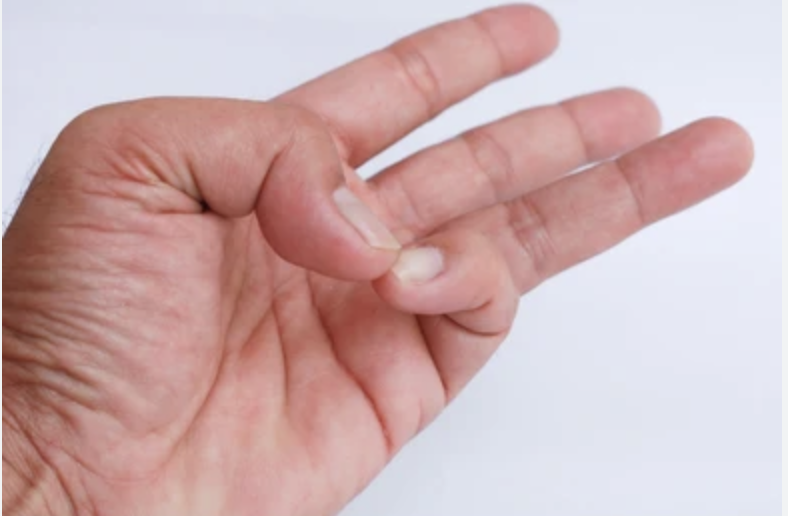
Except for us humans, the opposing thumb in the other species - that have one - is rudimentary. It is adequate for Chimps to grasp a twig as a tool to pry grubs out of holes, but useless for holding and manipulating delicate instruments and tools. We needed to go one step further. As we spread across the plains, we would realize that travelling across large distances was much easier (but not necessarily faster) if we were upright and used only our hind limbs for moving. With this adaptation, our forelimbs were now free to evolve into whatever best suited our new lifestyle as wandering hunter gatherers, and our hands achieved a unique and unmatched dexterity in the form of the Ulnar opposition. We are the only species whose thumbs can touch the tips of all the other four fingers. This left just one last barrier before we could be on our way to becoming inventors (I).
The Last Barrier (E12=Pscb)
Metallurgy (melting copper, then tin, etc.) was never necessary for our survival. In fact, most of our ancestors living about 6,000 years ago never made the transition from stone to copper and bronze. The map below shows the large tracts of land where the cultures remained in the stone age. A failing that would cost them dearly in the future.
On the other hand, we probably could not afford to pursue metallurgy or any other non-essential activity until survival was assured. So, we could look at all our achievements during the stone age as steps culminating in securing our future and freeing up resources for non-essential activities.
By the start of the stone age, our hands had evolved to include the Ulnar opposition, so we had the necessary physical attributes to start inventing and using sophisticated tools. But it still took us two million more years to be fully ready. During this time we mastered the science of making and using fire. Either accidently or deliberately we then started cooking the meat we killed. This made eating a lot easier and altered the structure of our teeth. Also, cooked meat was a lot easier to digest and provided the greater nutrition that our expanding brains would need. Our cranial capacity would increase threefold during this time. This allowed us to develop languages for working together, sharing ideas and planning ahead. We gave up our lifestyle of nomadic hunter gatherers and started living in settlements. Finally, between 10,000 and 5,000 BC we invented agriculture. This was a huge leap forward. Although still primitive, one man could now grow enough food to feed say five others, leaving the other four to pursue the study of the natural world. Now survival was not all consuming, and we were ready to explore the physical world we lived in. One would think the transition would have been natural and inevitable – but it wasn’t. The evidence suggests that it did pose a barrier we had difficulty crossing.
The reality is that two thirds of the planet (four Continents and all their cultures) remained in the stone age. A handicap that would leave them defenseless when European colonizers would later ‘discover’ them, rob them of their assets and make veritable slaves of them.
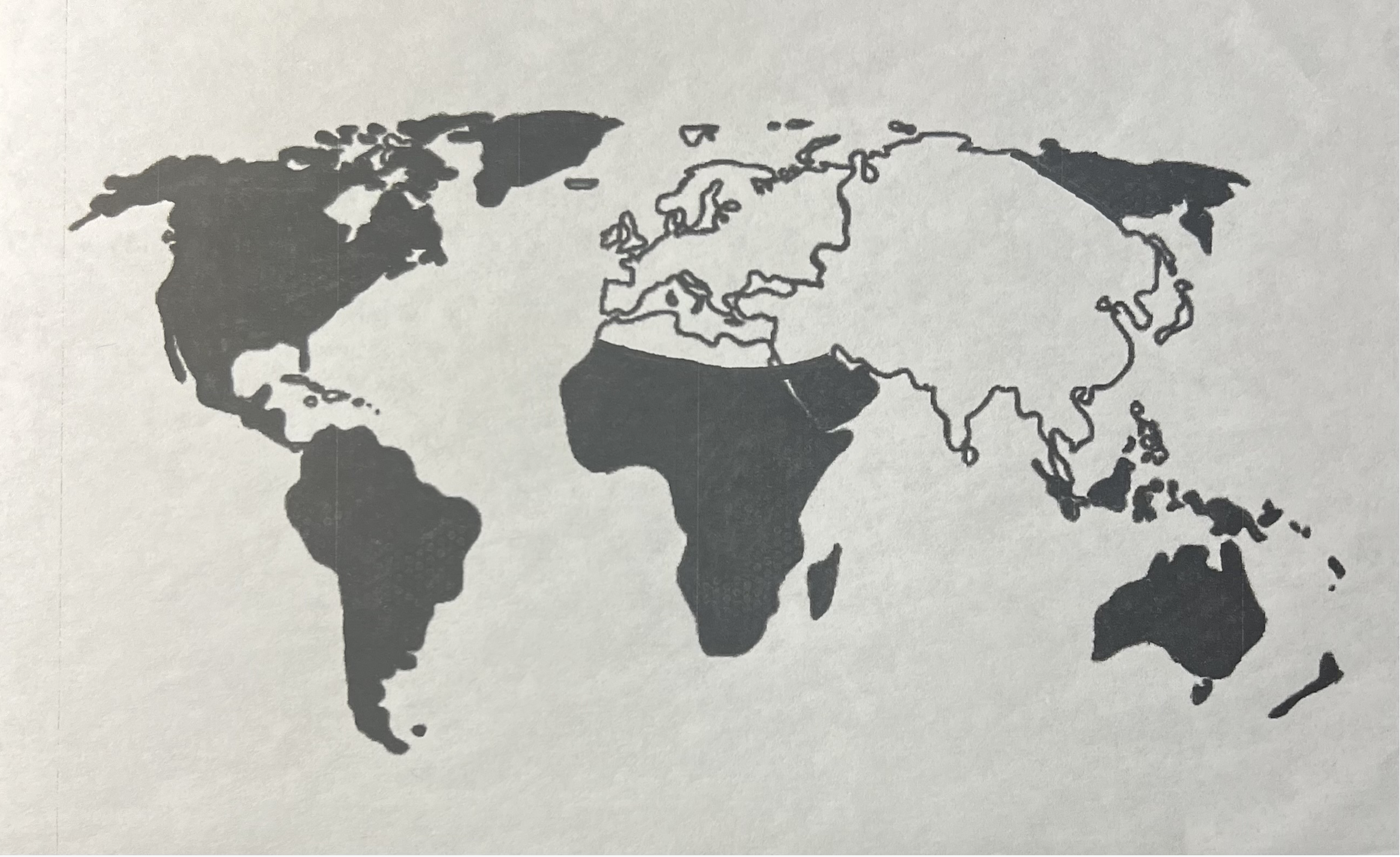
The areas in black are all the cultures that remained in the Stone Age
With two exceptions, most of the ‘left behind’ cultures were isolated in dense rain forests and probably had very limited cultivation. They were so isolated that the last one was only found at the end of the 20th century. For them survival probably continued to be time consuming, and metallurgy a distant thought.
The plains Indians of North America remained quintessential hunter gatherers. The Bison herds provided them with everything they needed for a good living, but at a cost. They were constantly on the move following the migration routes of their food supply. Although they knew of fire, they had neither the time nor inclination to do anything with it.They were so far behind that when the Europeans turned up with their guns and locomotives, they had not even invented the wheel.
The Incas and the Aztecs pose a conundrum. They lived in settlements and practiced a little agriculture. They knew of fire, and even indulged in a bit of metallurgy, but only used this skill to create objects for religious and ceremonial purposes. So, in theory, they had all the prerequisites to push out of the stone age, but did not. Had they crossed this barrier like in Europe, the history of both the America’s might have been very different.
The evidence suggests that even for those cultures who would go forward, the transition was not automatic. Only a handful (maybe just three) clustered in the Fertile Crescent of the Eastern Mediterranean would push through. The map below shows the timing of when different regions did break out. The radial pattern of the spread clearly indicates a small initial breakthrough about 6,000 years ago, and that the other cultures acquired this knowledge by interaction with adjacent cultures over a span of thousands of years.
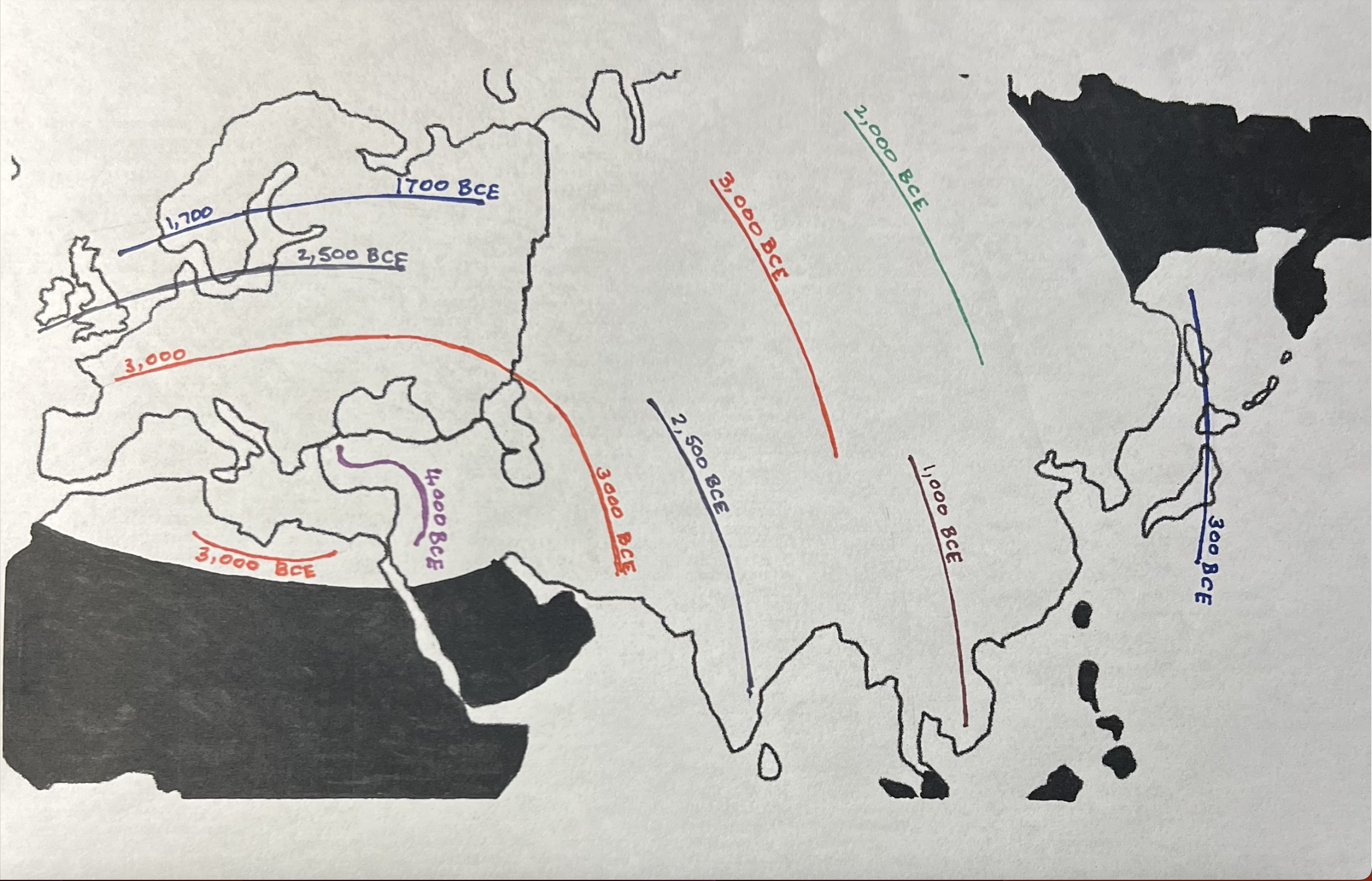
Timeline for the transition from stone to copper
What then might have pushed the first ones to break out? Once they did, the technological and military advantage it would give them would force their neighbors to follow suit or be enslaved. Which is exactly what happened to the ones who were left behind.
Threading the Eyes of a Million needles (E13=Pp)
If the goal is to populate a planet with a huge diversity of flora and fauna, evolution is the perfect mechanism. Let it do its thing and marvel at the profusion of life that will emerge. The problem is that its results are unpredictable. There is no telling what this life will look like. Two identical planets starting at the same time in identical environments may produce completely different species, just as our planet took completely different paths after each ELE.
Our diversity began at least 1.5 billion years ago with the appearance of complex multicellular lifeforms. Even if each subsequent evolutionary adaptation took one thousand years, this still amounts to 1.5 million changes between LUCA and us. What are the odds that such a singular thread would survive the mayhem we have just explored?
A parallel species may not look exactly like us, but if it is going to emulate our ability to discover and invent, it needs to have the core physical and intellectual characteristics of our species. These include:
A wide range of limb movement
Ulnar opposition for grasping and manipulating
Forward-facing eyes for depth perception
A greater emphasis on color vision over the other senses
Large brains relative to body size
Highly evolved problem-solving skills, and
Complex communication skills for learning and sharing knowledge.
Even the nearest Stars are too far away!
Our nearest stellar neighbors are a trio of stars called Alpha Centauri. Based on what we know now, none of their planets can support advanced life forms. But, to understand the enormity of the task, let us assume that we decide to build a spaceship to go there, a distance of just over 4 light years (Ly.)
The speed of light is about 670 million miles (about 1078 million km) per hour. The fastest speed we have achieved for a manned spacecraft is about 25,000 mph - Apollo 10 on its way home from the Moon. At this speed it would take about 140,000 years to complete this journey of 4 Ly – just in one direction! Clearly, this is impractical. If we are limited to what we can achieve with our existing chemical propulsion systems, we would be hard pressed to exceed Mach 14 or 10,654 mph. Apollo 10 got there by doing a sling shot around the moon.
We would need to somehow go thirty thousand times faster, say half the speed of light, and the journey would still take almost 9 years in each direction. Bear in mind that we have no understanding of what happens to a human body at these speeds, nor what kind of propulsion system will get us to this speed, and a collision with any object at this velocity will puncture the airtight hull with catastrophic consequences. Nonetheless, let us continue building this hypothetical spaceship.
The average human is only comfortable and functional at a steady gravitational force of 1G. So, on departure from Earth our spaceship would need to accelerate at a constant rate of 1G for about 200 days, at which time it will be travelling at about half the velocity of light. It would then need to coast at this velocity for about seven years before starting a long deceleration also at 1G for another 200 days.
During these seven long years, without creating some form of artificial gravity, the crew would be in a constant state of free fall. Is it possible for humans to live and work in zero gravity for such a long time? Probably not. So, some form of artificial gravity will have to be generated to keep the crew comfortable.
So, our spaceship needs to have enough fuel to accelerate/decelerate at 1G for 400 days in one direction, then four hundred more days in the other direction (assuming the crew wants to return home). It also needs to maintain a force of 1G for another fourteen years and provide life support to the crew of say 10 for about 17 years. After all this, if the crew is lucky, they will find their destination planet and establish an orbit around it, explore it and return home. The size of such a ship would be enormous. For example, it would need to carry about 30,000 pounds of food and water for each crew member etc. Such a ship is not going to appear as a fast-moving blip on a Navy Jet’s radar!
Of the 20 stars nearest to us, the farthest one is about twelve Ly away. It is not likely that any of them can support even simple life. If the blips appearing on the radars of our Navy jets are indeed Alien craft, then they have travelled a very long way to get here, and they have a significantly different understanding of space and time, and how to traverse them. Their technology is probably hundreds of years more advanced than ours, and we could only meet them if they wanted to meet us!
The Wooly Mammoth in the Room!
It’s time to confront the big question we have been pondering for ages. What are we? Accident or creation? If a creation, then why would an Omnipotent and Omniscient creator dick around with eons full of improbable events when he/she/it could just wave one of its appendages around like a magic wand and make it all happen in just six days? Why indeed?
If we accept that we are an accident – albeit a very improbable one - then the probability of our (and others like us) existence is just a numbers game. It was only in the last century that we tried to quantify the probability of such parallel civilizations. The first such – and still used - formula was proposed by a team of scientists led by radio astronomer Frank Drake in 1961. It is an extremely loosey-goosey equation and lends itself to equally loosey-goosey, and often optimistic conclusions. The difference between these optimistic conclusions and the observed reality is so large that it amounts to a paradox!
The method for creating an alternate equation is straight forward. We should identify every event that was essential to our journey – as we have done here. For each of these events we need to make a guess at the probability of it happening again. These probabilities should all be proper fractions, and most will be quite small. When we multiply all these fractions together, the combined probability will be an extremely small number. However, when we multiply this by the possible number of stars in the Universe, things look promising. So yes, somewhere in the vastness of our Universe there are quite likely one or more Planets with civilizations like ours. The problem arises when we narrow it down to just the civilizations we might be able to communicate with in our lifetime. Now, the billions of other Galaxies and all their stars are quite out of reach and irrelevant. Even most of our own Galaxy is irrelevant. The only possible candidates are the stars within a distance of say 100 light years and now the probability collapses.
Reality seems to confirm such a conclusion. Despite all the advances in technology, and all the hours spent listening for the last half century, we have not heard from anyone out there! Maybe Fermi’s paradox is only relevant because the Drake Equation enables us to believe in unlikely possibilities.
Although the fundamental uncertainty of trying to determine the values of the various probabilities persists, a new equation based on what we have learned here may look like:
Ncc = (S100Ly x 0.2) x Phz x Pt x Pw x Pm x Pa x Poc x Pab x Pgeo x Pp x Pot x Puo x Pscb x Pep
Where:
Ncc is the possible number of ET civilizations capable of communicating with us within the next few generations,
1. S100Ly is the total number of stars within a sphere with a radius of 100Ly from Earth. The 0.2 multiplier eliminates the Red Dwarfs.
2. Phz is the probability that a Star has an exoplanet in its HZ,
3. Pt is the probability that this planet is terrestrial,
4. Pw is the probability that the exoplanet acquires sufficient water,
5. Pm is the probability that the planet’s axis is inclined at a desirable angle and it has a moon of the right size,
6. Pa is the probability that the planet is of the right size to support an atmosphere,
7. Poc is the probability that on this planet inorganic compounds turn into organic compounds,
8. Pab is the probability that abiogenesis occurs, and primitive life emerges,
9. Pgoe is the probability that excess Oxygen is formed in its atmosphere, allowing multicellular life to emerge on the planet’s surface. This is a prerequisite for evolution to do its thing on the surface,
10. Pp is the probability of a species evolving into primates. Probably don’t need to be mammals,
11. Pot is the probability that somehow these primates acquire an opposing thumb,
12. Puo is the probability that the opposing thumb further evolves into the Ulnar opposition,
13. Pscb is the probability that this species becomes self-aware and can push through the stone-copper boundary, and,
14. Pep is the probability that an evolutionary path survives from first life to a BIDA civilization.
Unless an incoming signal is aimed directly at us, 100 Ly is probably the greatest distance at which a dispersed signal can be captured. By extrapolating what we see in the space around us, we can estimate that there might be about 20,000 stars in a sphere with a radius of 100 Ly. Dropping the 80% that are red dwarfs leaves us with only 4,000 possible candidates. The above equation involves the probabilities for 13 required events. Even if each of them had a probability of 50% (an impossibly high number) we would only have one chance in 8,192 of finding a comparable BIDA level civilization within this sphere! The numbers are inescapable. Even looking out 100 Ly we are unlikely to encounter anyone. We can keep listening if we want to, but nothing is coming our way!
Pot will Probably be the other showstopper. Our migration to the trees and then back to the ground were accidental consequences of cosmic catastrophes and may never occur again, so it is quite likely that a vast number of habitable planets will only have primitive primate-like creatures firmly ensconced in some variation of the stone age, but incapable of breaking out. Keep listening if you want to, but no messages are going to come our way!
Strange Stuff
PURGY’S FLIGHT
The study of fossils can be inconclusive. If you find a fossil, then it is fairly certain that a member of that species died nearby. Not finding one does not mean the species did not hang around there, it may just mean that you haven’t found its remains! The assumption is that if you look assiduously and still don’t find anything, then they were never there. This uncertainty puts an interesting twist on the story of Purgy and its descendants.
Despite extensive searching, Purgy’s remains have only been found in one smallish location. A narrow wedge stretching from Fort Union in Wyoming northwest to the Scollard formation in Alberta and sandwiched between 106- and 113-degrees West Longitude. In fact, Purgy’s name is derived from Purgatory, Montana. Thus, even though Africa is considered the birthplace of our species, our roots really go back to this narrow wedge of real estate in North America.
Purgy’s immediate descendants were Plesiadapiforms followed by Anthropoids. Plesiadapiforms were the first true primates and lived about 60 to 55 million years ago. Just after the fifth ELE. Their hands had adapted for better grasping, and they had forward facing eyes and larger brains than Purgy. They had spread out from Purgy’s home base and their fossils have been found in Colorado, New Mexico, Belgium, France, England and China. So, a significant migration appeared to be taking place. Then, something strange happened. What appeared to be a migration might actually be a diaspora. After Plesiadapiforms, there is no trace of Anthropoids, Hominoids, Hominins or any of our other ancestors in N. America until Homo Sapiens (modern humans) appeared 13 thousand years ago. This is a span of about 50 million years during which we seemed to have just packed up and moved out of North America. A conclusion based solely on the absence of any fossil evidence but borne out by the absence of any monkeys or apes native to N. America. Is such a total emigration even possible in creatures that have little to no way of communicating with each other. Without language, how does one convince an entire species to pack up and leave their homeland?
Our ancestors that came to North America 13 thousand years ago were the Clovis culture. They almost certainly moved Northward from South America, where the earliest human remains date back to 14 or so thousand years ago. Then, as occasionally happens, we discovered an anomaly. Human artifacts were discovered in Mexico and New Mexico that date back to at least 21 thousand years ago. Maybe ALL the Anthropoids did not leave North America all those millions of years ago. What if some stayed, and we just haven’t found any trace of them! Again, how does one even find every specimen of a species that lives in the wild. And having found them, how does one convince them all to move away without any means of communicating with them!
TERRESTRIAL KILLERS!
About 3 thousand years ago we started keeping track of the various pathogens that were attacking us periodically. Three viruses emerge as both deadly and persistent: Measles, Polio, and Smallpox. Of themselves, viruses are acceptable consequences of the unpredictable machine that is evolution. But when they are non-zoonotic, as these three are, we need to wonder why. Being non-zoonotic, they have NO other hosts in nature! And there you have it. Three of the most virulent pathogens we know of have ONLY ONE purpose – to maim and kill humans!
What manner of existential pressure would drive a virus to be non-zoonotic? Especially when its only host lives in well-defined spaces. It was a death sentence. Vaccines were discovered, victims were isolated, and the viruses were strangled into extinction. But all is not lost. We have morons in power who would do away with the vaccines, and our killer friends might yet have a new lease on life.
Even though these three viruses killed millions, it apparently was not enough. Two bacteria – the plague and cholera - also piled on their share of killing. Cholera is interesting because it too seems to be focused on humans. It rarely affects other species and got to us via an essential ingredient – the water we drink.
The worst of the viral killers was smallpox. We believe we have eradicated it, and at least three generations of us have no resistance to it. We are assuming we are safe, but nobody seems to be asking how it managed to cross the Atlantic Ocean early in the 16th century on a crowded boat that took 35 days to do the crossing!
Finally, why jump through cosmic hoops to give us life, then jump through another set of hoops to take it away? A cauldron of conundrums. That’s what our story is!
We will be Alone
Although the odds against us being here are astronomically large, the Universe is almost infinitely vast, and to suggest that we are alone would be hubris. It is much easier to predict that when it comes to making actual contact with a parallel civilization in the foreseeable future, we will be alone.
This means that we have accidentally been given a potentially unique and incredible gift – not just self-awareness and life, but also the ability to reason and solve complex problems. This gift comes with a profound responsibility. Nobody and nothing else cares or might even know whether our species and its many accomplishments survives or dies. Our destiny and legacy are entirely in our own hands. Our spaceship home is a dynamic living entity, totally dependent on its star to keep it alive. Like all living entities, it will eventually die. If we treat it with respect, it will nourish us for millions of years before the laws of Physics make it inhospitable. If we continue to abuse it, the end will come much sooner but end it will.
This begs the question - what eventually happens to us and the multitude of species we share our home with? Millions of years should be enough time to find a way to save who and what we all are. However, given our current level of technology the problems appear insurmountable, and our continuing passion for self-destruction may render the future moot.
P.S. If some future generation does make a spaceship Ark, could they please leave the mosquitoes, fleas, ticks, bed bugs, lice and rats behind! Noah should have just let them drown. Think of all the plagues we could have avoided! Also, it would have been very helpful if he had left some notes behind telling us how he did it. There are over 10,000 species of birds alone! As for the beetles, OMG there are over a million species. Clearly the man was a genius. Can you imagine making over a million small wooden boxes to keep them all separate!