WE WILL BE ALONE
© Darius A Irani, 2025
We will Be alone

Ncc = (S100Ly x 0.2) x Phz x Pt x Pw x Pm x Pa x Poc x Pab x Pgoe x Pp x Pot x Puo x Pscb x Pep
What should we be looking for?
A few centuries ago, we realized that the white dots in the night sky were not manifestations of deities, but might be stars like our Sol. A little later we realized that only some of the dots were stars. The others were Galaxies, each with billions of stars of their own, and the reality of the size of our Universe began to sink in. Given the sheer number of stars with potential exoplanets, it was inevitable that we would ask ‘are we alone?’ Sadly, as we will see shortly, the distances are so vast, our technology so primitive, and our understanding of space and time so rudimentary, that we cannot hope to make physical contact with an ET civilization during our lifetime – unless they are advanced enough to reach us (and choose to.) The best we can hope for is to make virtual contact via radio transmissions – as we are trying to do now. This requires that they also have at least a similar capability to transmit and receive radio signals.
What does it take to be able to Transmit a Radio Signal (intelligence is not enough)
For us, even this limited ability came slowly over a span of millions of years. We now know that the emergence/discovery of even simple life is itself preceded by many steps, both evolutionary and environmental. After simple life came complexity, diversity through evolution and intelligence, but this too was not enough. Apes are considered to be ‘highly intelligent.’However, the likelihood that a tribe of Apes will ever build a radio telescope or launch a satellite is zero. We humans had to advance through four more stages beyond intelligence before we could transmit and receive radio signals. We started by pushing through the stone-copper barrier (B). This gave us simple skills in metallurgy and coupled with the unique evolutionary advantage of the Ulnar opposition allowed us to become inventors (I). We gradually invented more sophisticated tools, weapons and means of transportation. We then used our inventions to discover and explore (and subvert) the natural world we lived in (D). We explored the entire surface of our planet home and some of our oceans and a bit of the cosmos we lived in. Along the way we adapted to living in places we were never designed to go to – like outer space (A). In short, we became a BIDA level civilization and were finally ready to turn our attention to the vast and hostile environment our spaceship home travels through. It is hard to see how any other civilization could get to where we are without also going through these same steps. So, as we search through our Galaxy, this becomes the primary filter. What is the probability that a star/planet combination will go through steps similar to ours to enable another BIDA level civilization to emerge?
A Convoluted and Unpredictable Journey
Our journey took billions of years and required millions of environmental and evolutionary adaptations to get us to BIDA. Even if we knew what they all were, exploring each of them would be impossible. It is much more practical to home in on just the events that were essential to our journey. Fourteen of them have been identified in this essay. This list may not be complete, but with each new event we tack on the probability of finding a companion civilization gets smaller.
As we study our journey we will be in awe of the diversity of these events that had to happen in just the right sequence before we could get here. Cosmic catastrophes that had nothing to do with any evolutionary sequence would also shape our destiny in an unimaginable way. Despite the chaos and destruction of the five ELEs (some would say there were 6 if we count the extinction of most of the anaerobic bacteria during the GOE), the fickle and unpredictable mechanism of evolution would somehow find a path from LUCA to BIDA. Later, as we work with the numbers, we will have to confront the real possibility that we are an accident. We should not be here. At best we should have barely made it to the stone age, but not beyond. But we did, and here we are, ready to venture beyond the safety and comfort of our spaceship home, in our never-ending journey of discovery.
It's all in the Stars (E1)
The most common element in the Universe is Hydrogen. Stars are born when a cloud of Hydrogen gas under the gravitational pressure of its mass starts fusing the Hydrogen atoms into Helium and releases energy. Basically, a humongous Hydrogen bomb. A bomb that is a perfect balance between the explosive forces trying to tear it apart and the gravitational force keeping it together.
The story of all life - as we know it - begins and ends with a star. Ours began about 4.5 billion years ago when our Solar system was created out of a mass of Hydrogen gas called the Solar Nebula. 99.86% of the Nebula collapsed into itself to form our Sun. Which makes Sol hundreds of times larger than the rest of the solar system. Of the residual mass (0.14%), the two gas giants Jupiter (71%) and Saturn (21%) take up 92%. Everything else – planets, ice giants, moons, asteroids and comets must make do with the remaining 8%.
Of all the stars in our Galaxy, only one category – the Main Sequence Stars can sustain advanced life forms. Even within this category we are only interested in 3 types: Red Dwarfs; Orange Dwarfs; and Yellow Dwarfs like our Sol. Red Dwarfs make up 80% of the total, so understanding their role, if any, is essential.
As one would expect, the temperature in every planetary system declines as one travels from the surface of its Star to the outer reaches. Somewhere along this gradient is a zone where water can exist in liquid form. Astronomers call this the Habitable Zone (HZ). A terrestrial planet or moon in a star’s HZ can have surface water and can support life as we know it. Bear in mind that the word ‘life’ can mean anything from anaerobic bacteria clinging to Sulphur vents at the bottom of an ocean to a full-fledged BIDA civilization like ours.
To measure distances on a planet, miles would be an adequate unit. However, it is too small to measure interplanetary distances. Similarly, whereas a light year is a good unit for measuring inter stellar distances, it is too large for interplanetary distances. To address this, astronomers use a third measure called an AU (Astronomical Unit). Its value is 93 million miles or the radius of Earths (almost) circular orbit.
Sol’s HZ stretches from 0.95 AU to 1.67 AU. This places Earth (at 1 AU) close to the inner edge, and Mars at 1.5 AU also in, but close to the outer edge. Mercury and Venus are too hot to sustain water, and all the outer planets are too cold.
Red dwarfs are cooler than orange and yellow dwarfs, so their HZs are narrow and closer to their star. Any planet in the HZ will have a very short orbit lasting just days or weeks. Moreover, the planet would be tidally locked to the star like our Moon is to us. One half would always be in sunshine and hot, the other in darkness and icy cold. The only habitable area would be a narrow band in the twilight zone between night and day. Red dwarfs mainly emit Infra-Red light so photosynthesis – if it even occurred – would be very different. Whatever vegetation there is would not be green but much darker. Also, vision on such a planet would evolve very differently. Finally, red dwarfs are prone to emitting violent flares. Life may need to hide in caves. Building structures on the surface may not be viable. Survival would be a continuing challenge. It is unlikely that any life form would come even close to BIDA. So, 80% of the stars in our Galaxy are no longer contenders!
This leaves just the Orange Dwarfs (12% in number) and the Yellow Dwarfs like our Sol (7 to 8%) as potential stars that could support intelligent life forms. The consensus seems to be that the Orange Dwarfs would be more suitable mainly because of their relatively longer lifespans. My belief is that we will discover more intelligent civilizations in G-type systems. The more distant HZ, the much lower risk of Tidal Locking, the climate stability of a longer orbit and the fact that it has already happened with the Sun will override any advantage of the longer life span. Sadly, none of us will be around when this theory is either verified or disproven.
Within all dwarf stars, mass is constantly being converted into energy. Think Einstein’s E=MC2. Eventually, the decreasing gravitational force can no longer contain the fusion explosions, and the star starts expanding and dying. For Sol, this will be in about another 5 billion years. Long before then, Sol will have expanded enough to make life on Earth untenable, and we had better work together to find a way to get off it. The good news is that Jupiter may now be in the larger Sol’s HZ, and its terrestrial moons may be the nearest new home for us.
Look for the Rocks (E2=Phz, E3=Pt and E4=Pa)
Based on our Solar System, there seem to be only three types of planets. They are either terrestrial (Mercury, Venus, Earth and Mars) or gas giants (Jupiter and Saturn) or ice giants like Uranus and Neptune.
By their very definition, ice giants won't be in the star’s HZ. Uranus’ orbit is about 19 AU and Neptune’s about 30 AU. Even if they have moons, it will be too cold for any life to emerge on their surface.
A gas giant cannot support any life either. But they occasionally have terrestrial moons. So, a moon of a gas giant in a star’s HZ could be a good candidate for advanced life forms.
A terrestrial planet in the HZ is the obvious best choice.
Being in a HZ is no guarantee that a planet will have either an atmosphere or water. Many factors contribute to the ability to have and retain an atmosphere. Smaller planetslike Mercury or Mars with a low surface gravity will have a thin or no atmosphere. Larger planets like Earth will lose lighter gasses like Hydrogen but can retain the heavier gasses needed to support life. This makes the size of the planet also crucial in our search.
So here we are. Our journey has barely begun, and already, Nature had to find the right Star AND win the planetary trifecta of a terrestrial planet within a HZ and of the right size to be able to retain an atmosphere. By the time we get to the end of our journey, you might even agree with the improbability of our existence!
BIDA needed a Moon! (E5=Pm)
Surprisingly, on Earth, the emergence of our BIDA level civilization was significantly dependent on the inclination of our axis of rotation, and the effect of the Moon.
Without inclination, there would be no seasons. The equator would always be hot and the poles always freezing. The tropics may become so hot that they could be uninhabitable. Intelligent life would concentrate in a narrow mid-latitude temperate zone which would provide much less space for agriculture. There would be no need for species to migrate, possibly resulting in much lower biodiversity. A BIDA civilization could emerge, but the probability is much lower.
On the other hand, our moon plays a significant stabilizing role. Without it the Earth’s axis could wobble between 10 degrees and as much as 85 degrees, causing life threatening changes to the climate. At an extreme tilt angle the Equatorial region could be frozen and the poles unbearably hot! Without a stable climate, primates may have evolved very differently. Life may have concentrated in the oceans or near the poles. On land we may have been forced to burrow underground or hibernate to cope with extreme temperature swings. Getting to BIDA would have been much harder.
Without the Moon, our tides would be driven by just the gravitational pull of the Sun and would be a small fraction of what they are now (30%). Early life would delay its migration to land, and intelligent life might never have emerged.
Finally, the Moon has a major breaking effect on Earth’s rotation. Without it, we would spin 40 to 60% faster. Days would be much shorter - less than 18 hours long, and the greater angular velocity would result in a much stronger Coriolis force and more violent storms.
Presence Of Water – 4.5 billion Years Ago (E6=Pw)
Liquid water is essential for all our known lifeforms. Luckily, we have lots of it. About 366 quintillion gallons (3.66x10 to the power of 20.) Do we really need that much water? Probably not. Nor do we know exactly how it got here or exactly when. One theory is that we were repeatedly struck by water laden comets and asteroids. Another is that it was created at the time of the collision with the planet Theia and the creation of our Moon. What is agreed is that it appeared on the surface of the Earth very early in our journey and set the stage for what would follow.
Organic Compounds – 4.0 to 3.8 billion years ago (E7=Poc)
Before life could emerge, inorganic compounds had to be transformed into organic compounds. As far back as 1952, two scientists - Miller and Urey – recreated what the early conditions on Earth might have been and synthesized organic amino acids from inorganic elements. So, the transition from inorganic elements to organic compounds might happen quite naturally (with a high probability) in the early days of the formation of planetary systems with a watery exoplanet in the HZ. Although their first trace on Earth dates back to between 4.0 and 3.8 billion years ago, findings in meteorites suggest the process may have been happening much earlier.
First Life (Abiogenesis) – 4 billion Years Ago (E8=Pa)
The next step – the emergence of life – is a lot more uncertain. We have a theory of how organic compounds might transform themselves into living entities but are not able to reproduce it. And yet without this step, nothing else is possible!
Our best guess is that it happened between 3.8 and 4 billion years ago. The Earth was much hotter; the atmosphere had little oxygen, mainly methane, ammonia, carbon dioxide, and nitrogen. When stimulated, this primordial soup formed amino acids which are the building blocks of proteins. These in turn formed complex molecules and finally simple bacteria like life forms.
If we do find evidence that there once were simple life forms on Mars, it would be promising. If abiogenesis did occur on both the planets that are in Sol’s HZ then the probability of it occurring in other HZs is also quite high.
LUCA – 4 billion years ago
Four billion years ago the surface of the Earth was a barren wasteland and the atmosphere contained no Oxygen. Life comprised of primitive microbes living anaerobically on Sulphur next to underwater vents. At this point it is thought that all life on Earth was descended from a common ancestor. Then it split into the three branches we recognize today: Bacteria; Archaea, and Eukarya. LUCA (Last Universal Common Ancestor) is the hypothetical cell from which this division and subsequent diversity emerged. It is the root of the diagram commonly called the tree of life. Such an entity may not have actually existed but is consistent with Darvin’s theory of descent (evolution) from a single ‘primordial form.’
Waiting for Oxygen – 4 billion to 2.5 billion years ago (E9=Pgoe)
Fossils of Cyanobacteria date back 3.5 billion years, making them just about the oldest living things on our planet. They are still the largest and most important group of bacteria. About 2.7 billion years ago cyanobacteria evolved and started performing photosynthesis, which released Oxygen as a byproduct. However, because the oceans contained large amounts of dissolved iron and other sink elements, early oxygen was absorbed to produce rust etc. and made very little impact on the atmosphere.
Finally, about 2.33 billion years ago, Iron and the other sinks in the oceans were used up, and a small amount of Oxygen made a permanent presence in the atmosphere. This was the start of a rapid but not fully understood increase in atmospheric Oxygen. Scientists call this period the GOE (Great Oxygenation Event.) Although it probably took millions of years to compete, on a geological time scale it was quite sudden. At the end of the GOE the atmosphere contained enough Oxygen to support multicellular life on the surface.
Although the GOE was the precursor to the emergence of life on the surface and contributed to the creation of the ozone layer which protects us from harmful UV radiation, it was poisonous to most of the then existing anaerobic organisms and is also referred to as the oxygen catastrophe.
2 billion Years ago to 450 million years ago
For the next two billion odd years, evolution was able to do its thing, and multicellular life would flourish in the oceans.
450 To 250 million Years Ago - The First Three ELEs
There is some ongoing discussion about exactly how many ELEs we suffered through. There were two during the Cambrian period and one recently acknowledged during the Capitanian that are not included here. We will focus on just the five big ones.
We are not sure exactly what caused the ELEs, but they all have similar probable causes. Volcanoes erupt generating masses of greenhouse gasses, tectonic plates shift, air gets polluted and O2 levels fall, a short severe ice age takes its toll, oceans get contaminated, and large rocks hit the planet with enormous force. Over billions of years these kinds of events could happen to any planet otherwise trying to get some flora and fauna going. Maybe ELEs are a way of life (or death) in a planet’s history, and we are overdue for our next one! Still, they pose an interesting dichotomy. On the one hand we have totally unpredictable events each of which killed off at least 70% of all living species over millions of years followed by millions of years of rebirth and regeneration in equally unpredictable directions. New species emerge which might never have emerged otherwise. Many of the old species die off never to be seen again, and others manage to make it to the other side and live on. On Earth, this cycle was repeated at least five times. Yet, despite all the devastation, chaos and uncertainty, an evolutionary path survived from LUCA through to modern humans. How do we even begin to compute such a probability.
The first ELE about 450 million years ago was devastating to marine life. The surface of the planet was still barren. Over 80% of all species disappeared to be replaced by a host of new ones! This was immediately followed by the Cambrian explosion. An eruption of life on the surface which would continue for millions of years.
The second ELE was about 370 million years ago. Plants had already taken root on the surface, but the first reptiles and mammals had not yet emerged. Over 80% of marine species went extinct. Nature didn’t care. It just picked up the pieces and continued restoring plants and animals on the surface.
The third ELE was about 250 million years ago. This one was truly catastrophic. It was so murderous that it has been nick named ‘The Great Dying.’ 81% of marine species and 70% of terrestrial species were decimated. It ended the primacy of the early Synapsids and set the stage for the ascendancy of the dinosaurs.
An Essential Opposition (E10=Pot)
To prepare for what had to happen next, we need to take a small diversion.
Arguably, one of the most significant evolutionary adaptations on our journey to BIDA is the emergence of our opposing thumb! We take it for granted and ignore its rarity. In reality, an opposing thumb is way off the beaten path of evolution. There is no precise count of the number of species living on Earth. The number may be over ten million. Despite this enormous diversity, only a handful of species have been identified with having a truly opposing thumb. Mainly humans and the four great apes. All the millions of other species may be managing without it but will never progress beyond the most primitive way of life.
All the species with an opposing thumb have one thing in common - they all either are now or started out as arboreal creatures. Tree branches are generally round, so life in the trees favored a circular grip, which naturally evolved into an opposing thumb.
We may not live in the trees anymore, but our ancestors did, and their legacy of the opposing thumb is essential for everything we do. It was the start of us acquiring an ability to firmly grip and manipulate our tools, instruments and everything else. Pretend you don’t have a thumb for a few hours, and you will get the message. We could not have invented without our thumbs, and without our inventions we could never have got to BIDA.
250 million Years Ago – The Fourth ELE
Although the fourth ELE was only comparable to the first and second in its destructive power, its timing made it far more dangerous to mammals. The Synapsids had already been weakened by the third ELE and the fourth one just about did them in. Almost all the Therapsids and large amphibians were also killed off. As were most of the non-dinosaur archosaurs. This left the dinosaurs with little terrestrial competition, and over the next 190 million years they evolved into apex killing machines, and they ruled the plains with a ravenous appetite.
Purgy’s Plight
Although the earliest mammals date back over 200 million years ago, the earliest mammalian primates only date back about 70 million years. About five million years before the fifth ELE. They were not very big. About the size of a squirrel. From what their fossils tell us they might have looked like shrews, and they lived in trees. Their official designation is Purgatorius but we will call them Purgy.
Seventy million years ago, dinosaurs still ruled the earth, so Purgy – and its mamallian ancestors - had no choice but to find sanctuary in the trees. Purgy had adapted well to the challenges of an arboreal habitat. It had a relatively large brain, binocular vision, shoulder girdles which facilitated a large degree of movement in the upper limbs, and of course the opposing thumb. A very suitable prototype for us primates.
There was however one serious problem. As long as Purgy and its descendants were forced to hide in the trees, they (we) would barely make it to the stone age, but no further. It did not matter how intelligent our ancestors became, building a fire in a tree to melt copper was not going to work. If we were ever to get to BIDA, we had to be able to come down from the trees! It would take another catastrophe to provide the necessary ‘cosmic accident’ that would force us to do just that.
The Second Big Bang
One day, about 65 million years ago, there was a tremendous bang. A six-mile-long asteroid named Chicxulub had collided with the Earth. The skies got dark with dust and debris which blocked the sunshine. Without sunlight plants started dying off. Almost the entire food chain from the lowliest herbivores to the majestic T. Rex slowly died off. The fossil evidence suggests that one of the very few primates (maybe just two species) that survived was Purgy. This could mean that all primates, alive today, on the planet’s surface, are possibly descendant from Purgy.
The impact of the collision was so devastating that most of the vegetation burst into flames. A few trees might have survived along coastlines because of tsunamis. Purgy would be forced to descend to the ground and scavenge for grubs and whatever else it could find to eat. The good news was that most of the hungry reptiles were either dead or dying. This allowed Purgy’s descendants to take their opposing thumbs and spread out across the plains and continue the journey to becoming modern humans.
The Ultimate Opposition (E11=Puo)
Except for us humans, the opposing thumb in the other species - that have one - is rudimentary. It is adequate for Chimps to grasp a twig as a tool to pry grubs out of holes, but useless for holding and manipulating delicate instruments and tools. We needed to go one step further. As we spread across the plains, we would realize that travelling across large distances was much easier (but not necessarily faster) if we were upright and used only our hind limbs for moving. With this adaptation, our forelimbs were now free to evolve into whatever best suited our new lifestyle as wandering hunter gatherers, and our hands achieved a unique and unmatched dexterity in the form of the Ulnar opposition. We are the only species whose thumbs can touch the tips of all the other four fingers. This left just one last barrier before we could be on our way to becoming inventors (I).
The Last Barrier (E12=Pscb)
Metallurgy (melting copper, then tin, etc.) was never necessary for our survival. In fact, most of our ancestors living about 6,000 years ago never made the transition from stone to copper and bronze. The map below shows the large tracts of land where the cultures remained in the stone age. A failing that would cost them dearly in the future.
On the other hand, we probably could not afford to pursue metallurgy or any other non-essential activity until survival was assured. So, we could look at all our achievements during the stone age as steps culminating in securing our future and freeing up resources for non-essential activities.
By the start of the stone age, our hands had evolved to include the Ulnar opposition, so we had the necessary physical attributes to start inventing and using sophisticated tools. But it still took us two million more years to be fully ready. During this time we mastered the science of making and using fire. Either accidently or deliberately we then started cooking the meat we killed. This made eating a lot easier and altered the structure of our teeth. Also, cooked meat was a lot easier to digest and provided the greater nutrition that our expanding brains would need. Our cranial capacity would increase threefold during this time. This allowed us to develop languages for working together, sharing ideas and planning ahead. We gave up our lifestyle of nomadic hunter gatherers and started living in settlements. Finally, between 10,000 and 5,000 BC we invented agriculture. This was a huge leap forward. Although still primitive, one man could now grow enough food to feed say five others, leaving the other four to pursue the study of the natural world. Now survival was not all consuming, and we were ready to explore the physical world we lived in. One would think the transition would have been natural and inevitable – but it wasn’t. The evidence suggests that it did pose a barrier we had difficulty crossing.
The reality is that two thirds of the planet (four Continents and all their cultures) remained in the stone age. A handicap that would leave them defenseless when European colonizers would later ‘discover’ them, rob them of their assets and make veritable slaves of them.
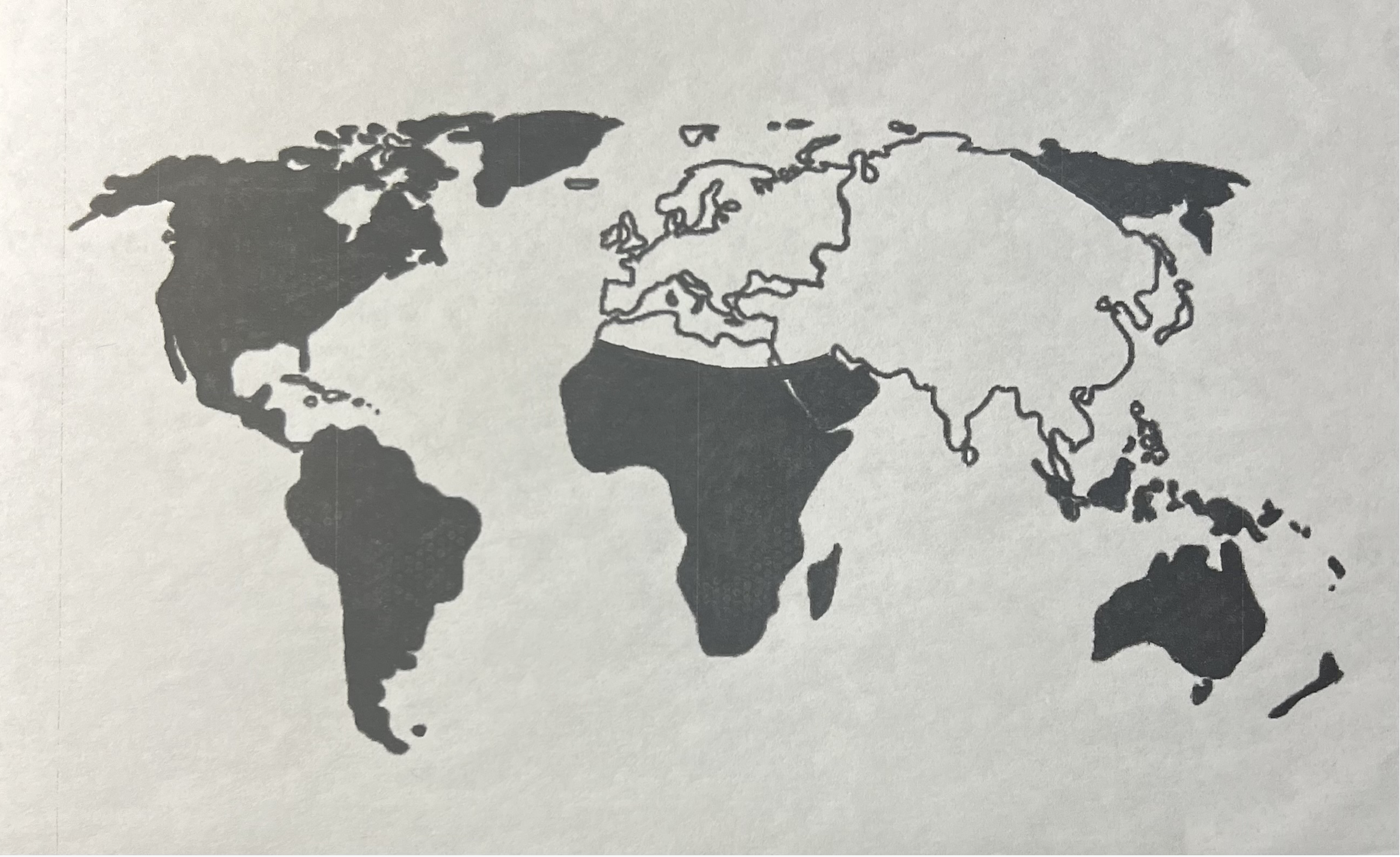
The areas in black are all the cultures that remained in the Stone Age
With two exceptions, most of the ‘left behind’ cultures were isolated in dense rain forests and probably had very limited cultivation. They were so isolated that the last one was only found at the end of the 20th century. For them survival probably continued to be time consuming, and metallurgy a distant thought.
The plains Indians of North America remained quintessential hunter gatherers. The Bison herds provided them with everything they needed for a good living, but at a cost. They were constantly on the move following the migration routes of their food supply. Although they knew of fire, they had neither the time nor inclination to do anything with it.They were so far behind that when the Europeans turned up with their guns and locomotives, they had not even invented the wheel.
The Incas and the Aztecs pose a conundrum. They lived in settlements and practiced a little agriculture. They knew of fire, and even indulged in a bit of metallurgy, but only used this skill to create objects for religious and ceremonial purposes. So, in theory, they had all the prerequisites to push out of the stone age, but did not. Had they crossed this barrier like in Europe, the history of both the America’s might have been very different.
The evidence suggests that even for those cultures who would go forward, the transition was not automatic. Only a handful (maybe just three) clustered in the Fertile Crescent of the Eastern Mediterranean would push through. The map below shows the timing of when different regions did break out. The radial pattern of the spread clearly indicates a small initial breakthrough about 6,000 years ago, and that the other cultures acquired this knowledge by interaction with adjacent cultures over a span of thousands of years.
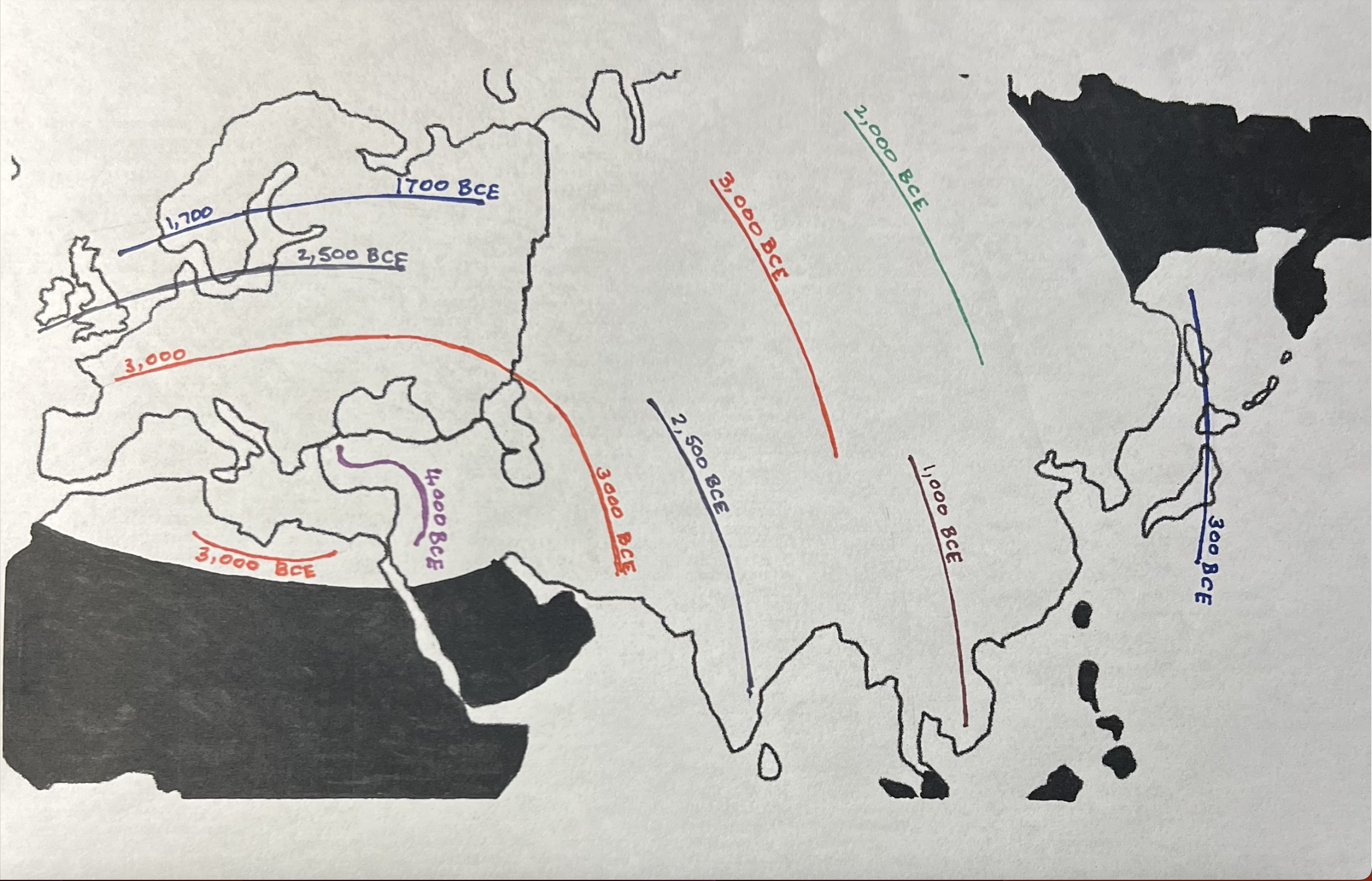
Timeline for the transition from stone to copper
What then might have pushed the first ones to break out? Once they did, the technological and military advantage it would give them would force their neighbors to follow suit or be enslaved. Which is exactly what happened to the ones who were left behind.
Threading the Eyes of a Million needles (E13=Pp)
If the goal is to populate a planet with a huge diversity of flora and fauna, evolution is the perfect mechanism. Let it do its thing and marvel at the profusion of life that will emerge. The problem is that its results are unpredictable. There is no telling what this life will look like. Two identical planets starting at the same time in identical environments may produce completely different species, just as our planet took completely different paths after each ELE.
Our diversity began at least 1.5 billion years ago with the appearance of complex multicellular lifeforms. Even if each subsequent evolutionary adaptation took one thousand years, this still amounts to 1.5 million changes between LUCA and us. What are the odds that such a singular thread would survive the mayhem we have just explored?
A parallel species may not look exactly like us, but if it is going to emulate our ability to discover and invent, it needs to have the core physical and intellectual characteristics of our species. These include:
A wide range of limb movement
Ulnar opposition for grasping and manipulating
Forward-facing eyes for depth perception
A greater emphasis on color vision over the other senses
Large brains relative to body size
Highly evolved problem-solving skills, and
Complex communication skills for learning and sharing knowledge.
Even the nearest Stars are too far away!
Our nearest stellar neighbors are a trio of stars called Alpha Centauri. Based on what we know now, none of their planets can support advanced life forms. But, to understand the enormity of the task, let us assume that we decide to build a spaceship to go there, a distance of just over 4 light years (Ly.)
The speed of light is about 670 million miles (about 1078 million km) per hour. The fastest speed we have achieved for a manned spacecraft is about 25,000 mph - Apollo 10 on its way home from the Moon. At this speed it would take about 140,000 years to complete this journey of 4 Ly – just in one direction! Clearly, this is impractical. If we are limited to what we can achieve with our existing chemical propulsion systems, we would be hard pressed to exceed Mach 14 or 10,654 mph. Apollo 10 got there by doing a sling shot around the moon.
We would need to somehow go thirty thousand times faster, say half the speed of light, and the journey would still take almost 9 years in each direction. Bear in mind that we have no understanding of what happens to a human body at these speeds, nor what kind of propulsion system will get us to this speed, and a collision with any object at this velocity will puncture the airtight hull with catastrophic consequences. Nonetheless, let us continue building this hypothetical spaceship.
The average human is only comfortable and functional at a steady gravitational force of 1G. So, on departure from Earth our spaceship would need to accelerate at a constant rate of 1G for about 200 days, at which time it will be travelling at about half the velocity of light. It would then need to coast at this velocity for about seven years before starting a long deceleration also at 1G for another 200 days.
During these seven long years, without creating some form of artificial gravity, the crew would be in a constant state of free fall. Is it possible for humans to live and work in zero gravity for such a long time? Probably not. So, some form of artificial gravity will have to be generated to keep the crew comfortable.
So, our spaceship needs to have enough fuel to accelerate/decelerate at 1G for 400 days in one direction, then four hundred more days in the other direction (assuming the crew wants to return home). It also needs to maintain a force of 1G for another fourteen years and provide life support to the crew of say 10 for about 17 years. After all this, if the crew is lucky, they will find their destination planet and establish an orbit around it, explore it and return home. The size of such a ship would be enormous. For example, it would need to carry about 30,000 pounds of food and water for each crew member etc. Such a ship is not going to appear as a fast-moving blip on a Navy Jet’s radar!
Of the 20 stars nearest to us, the farthest one is about twelve Ly away. It is not likely that any of them can support even simple life. If the blips appearing on the radars of our Navy jets are indeed Alien craft, then they have travelled a very long way to get here, and they have a significantly different understanding of space and time, and how to traverse them. Their technology is probably hundreds of years more advanced than ours, and we could only meet them if they wanted to meet us!
The Wooly Mammoth in the Room!
It’s time to confront the big question we have been pondering for ages. What are we? Accident or creation? If a creation, then why would an Omnipotent and Omniscient creator dick around with eons full of improbable events when he/she/it could just wave one of its appendages around like a magic wand and make it all happen in just six days? Why indeed?
If we accept that we are an accident – albeit a very improbable one - then the probability of our (and others like us) existence is just a numbers game. It was only in the last century that we tried to quantify the probability of such parallel civilizations. The first such – and still used - formula was proposed by a team of scientists led by radio astronomer Frank Drake in 1961. It is an extremely loosey-goosey equation and lends itself to equally loosey-goosey, and often optimistic conclusions. The difference between these optimistic conclusions and the observed reality is so large that it amounts to a paradox!
The method for creating an alternate equation is straight forward. We should identify every event that was essential to our journey – as we have done here. For each of these events we need to make a guess at the probability of it happening again. These probabilities should all be proper fractions, and most will be quite small. When we multiply all these fractions together, the combined probability will be an extremely small number. However, when we multiply this by the possible number of stars in the Universe, things look promising. So yes, somewhere in the vastness of our Universe there are quite likely one or more Planets with civilizations like ours. The problem arises when we narrow it down to just the civilizations we might be able to communicate with in our lifetime. Now, the billions of other Galaxies and all their stars are quite out of reach and irrelevant. Even most of our own Galaxy is irrelevant. The only possible candidates are the stars within a distance of say 100 light years and now the probability collapses.
Reality seems to confirm such a conclusion. Despite all the advances in technology, and all the hours spent listening for the last half century, we have not heard from anyone out there! Maybe Fermi’s paradox is only relevant because the Drake Equation enables us to believe in unlikely possibilities.
Although the fundamental uncertainty of trying to determine the values of the various probabilities persists, a new equation based on what we have learned here may look like:
Ncc = (S100Ly x 0.2) x Phz x Pt x Pw x Pm x Pa x Poc x Pab x Pgeo x Pp x Pot x Puo x Pscb x Pep
Where:
Ncc is the possible number of ET civilizations capable of communicating with us within the next few generations,
1. S100Ly is the total number of stars within a sphere with a radius of 100Ly from Earth. The 0.2 multiplier eliminates the Red Dwarfs.
2. Phz is the probability that a Star has an exoplanet in its HZ,
3. Pt is the probability that this planet is terrestrial,
4. Pw is the probability that the exoplanet acquires sufficient water,
5. Pm is the probability that the planet’s axis is inclined at a desirable angle and it has a moon of the right size,
6. Pa is the probability that the planet is of the right size to support an atmosphere,
7. Poc is the probability that on this planet inorganic compounds turn into organic compounds,
8. Pab is the probability that abiogenesis occurs, and primitive life emerges,
9. Pgoe is the probability that excess Oxygen is formed in its atmosphere, allowing multicellular life to emerge on the planet’s surface. This is a prerequisite for evolution to do its thing on the surface,
10. Pp is the probability of a species evolving into primates. Probably don’t need to be mammals,
11. Pot is the probability that somehow these primates acquire an opposing thumb,
12. Puo is the probability that the opposing thumb further evolves into the Ulnar opposition,
13. Pscb is the probability that this species becomes self-aware and can push through the stone-copper boundary, and,
14. Pep is the probability that an evolutionary path survives from first life to a BIDA civilization.
Unless an incoming signal is aimed directly at us, 100 Ly is probably the greatest distance at which a dispersed signal can be captured. By extrapolating what we see in the space around us, we can estimate that there might be about 20,000 stars in a sphere with a radius of 100 Ly. Dropping the 80% that are red dwarfs leaves us with only 4,000 possible candidates. The above equation involves the probabilities for 13 required events. Even if each of them had a probability of 50% (an impossibly high number) we would only have one chance in 8,192 of finding a comparable BIDA level civilization within this sphere! The numbers are inescapable. Even looking out 100 Ly we are unlikely to encounter anyone. We can keep listening if we want to, but nothing is coming our way!
Pot will Probably be the other showstopper. Our migration to the trees and then back to the ground were accidental consequences of cosmic catastrophes and may never occur again, so it is quite likely that a vast number of habitable planets will only have primitive primate-like creatures firmly ensconced in some variation of the stone age, but incapable of breaking out. Keep listening if you want to, but no messages are going to come our way!
Strange Stuff
PURGY’S FLIGHT
The study of fossils can be inconclusive. If you find a fossil, then it is fairly certain that a member of that species died nearby. Not finding one does not mean the species did not hang around there, it may just mean that you haven’t found its remains! The assumption is that if you look assiduously and still don’t find anything, then they were never there. This uncertainty puts an interesting twist on the story of Purgy and its descendants.
Despite extensive searching, Purgy’s remains have only been found in one smallish location. A narrow wedge stretching from Fort Union in Wyoming northwest to the Scollard formation in Alberta and sandwiched between 106- and 113-degrees West Longitude. In fact, Purgy’s name is derived from Purgatory, Montana. Thus, even though Africa is considered the birthplace of our species, our roots really go back to this narrow wedge of real estate in North America.
Purgy’s immediate descendants were Plesiadapiforms followed by Anthropoids. Plesiadapiforms were the first true primates and lived about 60 to 55 million years ago. Just after the fifth ELE. Their hands had adapted for better grasping, and they had forward facing eyes and larger brains than Purgy. They had spread out from Purgy’s home base and their fossils have been found in Colorado, New Mexico, Belgium, France, England and China. So, a significant migration appeared to be taking place. Then, something strange happened. What appeared to be a migration might actually be a diaspora. After Plesiadapiforms, there is no trace of Anthropoids, Hominoids, Hominins or any of our other ancestors in N. America until Homo Sapiens (modern humans) appeared 13 thousand years ago. This is a span of about 50 million years during which we seemed to have just packed up and moved out of North America. A conclusion based solely on the absence of any fossil evidence but borne out by the absence of any monkeys or apes native to N. America. Is such a total emigration even possible in creatures that have little to no way of communicating with each other. Without language, how does one convince an entire species to pack up and leave their homeland?
Our ancestors that came to North America 13 thousand years ago were the Clovis culture. They almost certainly moved Northward from South America, where the earliest human remains date back to 14 or so thousand years ago. Then, as occasionally happens, we discovered an anomaly. Human artifacts were discovered in Mexico and New Mexico that date back to at least 21 thousand years ago. Maybe ALL the Anthropoids did not leave North America all those millions of years ago. What if some stayed, and we just haven’t found any trace of them! Again, how does one even find every specimen of a species that lives in the wild. And having found them, how does one convince them all to move away without any means of communicating with them!
TERRESTRIAL KILLERS!
About 3 thousand years ago we started keeping track of the various pathogens that were attacking us periodically. Three viruses emerge as both deadly and persistent: Measles, Polio, and Smallpox. Of themselves, viruses are acceptable consequences of the unpredictable machine that is evolution. But when they are non-zoonotic, as these three are, we need to wonder why. Being non-zoonotic, they have NO other hosts in nature! And there you have it. Three of the most virulent pathogens we know of have ONLY ONE purpose – to maim and kill humans!
What manner of existential pressure would drive a virus to be non-zoonotic? Especially when its only host lives in well-defined spaces. It was a death sentence. Vaccines were discovered, victims were isolated, and the viruses were strangled into extinction. But all is not lost. We have morons in power who would do away with the vaccines, and our killer friends might yet have a new lease on life.
Even though these three viruses killed millions, it apparently was not enough. Two bacteria – the plague and cholera - also piled on their share of killing. Cholera is interesting because it too seems to be focused on humans. It rarely affects other species and got to us via an essential ingredient – the water we drink.
The worst of the viral killers was smallpox. We believe we have eradicated it, and at least three generations of us have no resistance to it. We are assuming we are safe, but nobody seems to be asking how it managed to cross the Atlantic Ocean early in the 16th century on a crowded boat that took 35 days to do the crossing!
Finally, why jump through cosmic hoops to give us life, then jump through another set of hoops to take it away? A cauldron of conundrums. That’s what our story is!
We will be Alone
Although the odds against us being here are astronomically large, the Universe is almost infinitely vast, and to suggest that we are alone would be hubris. It is much easier to predict that when it comes to making actual contact with a parallel civilization in the foreseeable future, we will be alone.
This means that we have accidentally been given a potentially unique and incredible gift – not just self-awareness and life, but also the ability to reason and solve complex problems. This gift comes with a profound responsibility. Nobody and nothing else cares or might even know whether our species and its many accomplishments survives or dies. Our destiny and legacy are entirely in our own hands. Our spaceship home is a dynamic living entity, totally dependent on its star to keep it alive. Like all living entities, it will eventually die. If we treat it with respect, it will nourish us for millions of years before the laws of Physics make it inhospitable. If we continue to abuse it, the end will come much sooner but end it will.
This begs the question - what eventually happens to us and the multitude of species we share our home with? Millions of years should be enough time to find a way to save who and what we all are. However, given our current level of technology the problems appear insurmountable, and our continuing passion for self-destruction may render the future moot.
P.S. If some future generation does make a spaceship Ark, could they please leave the mosquitoes, fleas, ticks, bed bugs, lice and rats behind! Noah should have just let them drown. Think of all the plagues we could have avoided! Also, it would have been very helpful if he had left some notes behind telling us how he did it. There are over 10,000 species of birds alone! As for the beetles, OMG there are over a million species. Clearly the man was a genius. Can you imagine making over a million small wooden boxes to keep them all separate!

NATURE WILL SURVIVE - PART 1. A CERTIFIABLE SPECIES
© Darius A Irani, 2023
A CERTIFIABLE SPECIES
About 390 million years ago life crawled out of the oceans and began the long process of populating the land surface of our planet. During this long childhood, Nature would be interrupted five times by extinction level events. Nature did not care. It measures its progress in millions of years and millions of little changes. It just picked up the pieces and continued its inexorable journey to wherever it is going. The last extinction level event was about 65 million years ago. When it was done, the largest surviving land mammal was a tree dwelling, shrew like creature, about the size of a shoe box. The good news was that the hungry reptiles that had ruled over the plains were all gone. This allowed mammalian life to leave the safety of the trees and slowly move onto the plains. Evolution did its thing, and what we see around us is the result - an unimaginable diversity of plant and animal life.
We call our home a planet. It is a moniker that dates back two thousand years. The early Greeks could look up at the night sky and almost everything they saw reaffirmed their geocentric view of the universe. The Sun, Moon and all the stars appeared to revolve around the earth exactly as they were supposed to. However, there were seven objects whose behavior was totally unpredictable. Because they seemed to meander all over the sky, the Greeks decided to call them wanderers, which in Greek is the word planetes. What we now know is that both the geocentric and subsequent heliocentric views of the universe were totally incorrect. Our Planet is not at the center of anything. Our Sun is merely an average star in an obscure quadrant of an insignificant galaxy. The wanderer we call home is actually a spaceship. It may not look anything like the International Space Station or how Hollywood depicts spaceships, but none the less it is one. It is hurtling through interplanetary space at about 66,000 mph while managing to keep everything together and keep us alive.
Interplanetary space is about the deadliest environment a living creature can find itself in. Besides having no air, water or food, the temperature is minus 450 degrees F. At this temperature, all water-based life forms - like us - would become chunks of ice in just a few minutes. The ONLY reason we exist is because of the protection and nourishment provided by our spaceship home. Yet, in our boundless stupidity we are doing everything we can to destroy it.
On our planet, all land-dwelling creatures need four things to survive, prerequisites if you will: Air (Oxygen) to breathe; Water for hydration; Food for nourishment; and a suitable environment to live in. There is a useful rule of thumb that underscores our total dependence on these four items. We humans can only survive for about three minutes without air, three hours in dangerous temperatures, three days without water, and, three weeks without food. A few hundred years from now, if there are still any historians around, they will be astounded by our apparent determination to self destruct. What - they will wonder - drove us to pollute our air, contaminate our water, overwhelm our food producing resources, and push our environment over a brink from which it might not return. What is unconscionable is that in our selfishness and greed, we will also eradicate all the other species we share our home with.
(Would be survivalists should take heed. All the prerequisite are unyielding. Look at the whole picture. Having enough food for many years won’t do you any good if you are going to die in one week because you don’t have any potable water!)
The Last Glacial Period ended about 11,000 years ago. At that time all the species were in balance. No species had a clear advantage. Life and death were equally uncertain in the struggle to survive. For whatever reason and in whatever way, one species - humans - began to surpass all the others, both intellectually and culturally. So much so that now, we can on a whim eradicate any other species that we want to. No other species can do this. We harbor the delusion that we are modeled in the image of some deity. This somehow makes us superior to and gives us dominance over all other life that we share this planet with. Consequently, we believe that perpetuating ourselves is the highest priority, and if other species fall by the wayside, so be it.
Our greatest construction projects are miniscule in scope compared to the size of our planet. This should be a warning that if we break something we have neither the skills nor the material needed to fix it. If what we break provides one of the four prerequisites for life – life will end. Nature will not care. It has seen it all five times before. A few million years from now, new life will emerge. It may not look anything like what we now see around us, but Nature WILL survive – we won’t.
At the very core of our selfishness is our population. Some scientists estimate that our planet was designed to support about 3 billion humans. Let’s be generous and say 4 billion. Our actual population has just surpassed 8 billion. This is madness. The only other spaceship we can draw a parallel with is the International Space Station. It is designed to support a crew of seven. Would we dare to pack it with 14 humans – of course not. There would not be enough air, water or food. It would be suicidal. Why then are we doing on a scale of billions what we would not dare to do on the scale of a dozen? The answer probably lies somewhere between ignorance and complacency with a lot of greed mixed in. Our home has tolerated and absorbed our excesses for so long that we believe we can keep on abusing it with no consequences. This is a potentially fatal fallacy. We are on a spaceship. Spaceships are finite, bounded and surrounded by infinite danger. If we kick it often enough it will break. A few years from now, if what we thought were hundred year weather events start occurring annually, we will realize that it is too late. The slippery slope to extinction is not very steep, but it is merciless and implacable. We will have lots of time to do what we seem to do best - point fingers and blame each other while doing nothing!

NATURE WILL SURVIVE - PART 2. EATING THE WHOLE DAMN FRUIT SALAD
© Darius A Irani, 2023
EATING THE WHOLE DAMN FRUIT SALAD.
Most of us have no idea of the specific events that had to occur in just the right sequence over the last 4 billion years before complex life could emerge on our planet. Could the same sequence have happened somewhere else - possibly. When one is dealing with billions of galaxies each with billions of stars, to claim uniqueness would be hubris. However, the odds of us reaching such a planet are very small even if we could predict where it would be when we finish our journey. The distances are so vast and our technology so primitive, that it would take thousands of years just to exit the Oort Cloud at the very edge of our solar system. No electromechanical devices could function for even a minute fraction of the duration of the journey, the spaceship would only be able to transport a few dozen earthlings, and the generation that started the journey would be old before they even got to Neptune. There is no Plan B. This beautiful blue orb is all we have. If we destroy it, everything we have done and accomplished will be destroyed with it. Maybe, just maybe, if we understand the odds that Nature had to overcome to bring it all together, we might better appreciate the gift of life we have been given. We might even realize that our ideologies, religions, wealth, power and all the other stupid things we fight over are meaningless. The ONLY thing that matters is preserving our spaceship home.
Useful Information
A mile (or Kilometer) is too small a unit to measure inter-planetary distances within our Solar system. On the other hand, a Light-year is more suitable for measuring interstellar distances, but too large for inter-planetary gaps. Consequently, astronomers have identified an intermediary unit of length for measuring distances within the solar system – The Astronomical Unit (AU). The Earth’s orbit is almost circular with a radius averaging about 93 million miles (about 149 million km). The difference in the radii between perihelion and aphelion is only about 3.16 million miles. This average radius of 93 million miles is the dimension of an AU. The closest planet to the Sun is Mercury with an orbital radius of only 0.387 AU, and furthest is Neptune at about 30 AU. At the furthermost reaches of our solar system is the Oort cloud at a staggering 5,000 to 10,000 AU
Almost all life on our planet is inextricably tied to water and oxygen. The appearance of these two substances represents significant turning points in the emergence and evolution of complex organisms on the planet’s surface. Consequently, as we explore our origins, these two substances are on the top of the list for prerequisites. Can life exist without Oxygen? Yes, it can. There are simple organisms that get their energy from Sulphur and not Oxygen. However, these are very primitive organisms. Very few of these are multicellular, and none comprise more than a dozen or so cells.
Location is Everything
All stars have a defined orbital area called the habitable zone (HZ). Within this zone it is not too hot or too cold and a planet can sustain water on its surface. For any given star, the distance of this zone from the star, and its extent depends on the size and luminosity of the star. An orbit closer than the HZ would result in high surface temperatures and water would be lost by heat and the greenhouse effect. Incoming infrared radiation would be trapped, and the water would boil away. At greater distances, the greenhouse effect would be inadequate to prevent the water from freezing. Within our solar system Earth is the only planet within this zone. Mercury and Venus are too close to the Sun, and Mars together with all the outer gas giants are outside this zone. We are barely in it!
Sol’s habitable zone stretches from 0.9 AU to 1.5AU. Some estimates suggest that the inner boundary may be 0.95 AU or even 0.99 AU. Thus, we are right on the brink of being too hot to hold any water. This makes our headlong rush towards global warming an even greater act of insanity. If we were just 2.5 million miles closer to the sun, life would not exist. Be that as it may, the Earth came together as a planet at just the right distance from the sun and here we are.
Size Matters
Large stars have life spans measured in just millions of years. Complex life on Earth took about 3 billion years to emerge. Consequently, had our Sun been much larger, the Earth would not have had enough time for life to emerge and evolve into the diversity and complexity we see around us.
Very small stars (red dwarfs) pose their own limitations. They are much cooler than the sun, so their habitable zone is much closer and narrower. The immediate consequence is that any planet in the HZ would be tidally locked to the star, preventing it from rotating. One half would always face the star and the other would be in perpetual darkness - just like our moon. Life on such a planet would be both different and unpleasant. For starters, these small stars emit mainly Infra-Red radiation, so on the star side vision would have evolved to work in this wavelength. Whereas the other side would have adapted for almost total darkness. Yet again we beat the odds and got a star that was the right distance away and would give us heat and energy for 10 billion years. Now all we needed was Oxygen.
Cyanobacteria Save the Day
The air we breathe is composed of 78.09% Nitrogen, 20.95% Oxygen, 0.93% Argon, 0.039% Carbon dioxide and traces of other gases. It was not always so. In the beginning - 4.6 billion years ago – our atmosphere was composed of Methane, Hydrogen Sulfide, and much Carbon Dioxide, but no Oxygen. Primitive microbes were present, living anaerobically on Sulfate. The surface of our planet must have been a desolate landscape. Almost Lunar in appearance, bereft of plant or animal life. Six hundred million years later the oceans had formed, but there was still no Oxygen in the atmosphere. If it were not for the Cyanobacteria, this would have been the end of the story. Strictly speaking, there would have been no story at all because there would be no one to write it.
Fossils of Cyanobacteria date back 3.5 billion years making them just about the oldest living things on our planet. They are still the largest and most important group of bacteria. They produce Oxygen as a byproduct of photosynthesis and are responsible for the original presence of Oxygen in our atmosphere. Oxygen, however, is a very clingy element. It easily bonds to other elements e.g., Iron to form rust. So, in the early stages, whatever Oxygen was produced in the atmosphere would quickly be absorbed by the so called “sink” elements like Iron.
Finally, about 2.33 billion years ago a small amount of Oxygen made a permanent presence in the atmosphere. This was the start of a rapid but not understood increase in atmospheric Oxygen. Scientists call this period the GOE (Great Oxygenation Event). At the end of the GOE the atmosphere contained enough Oxygen to support multicellular life, which is a prerequisite for complex organisms to evolve. The stage was now set. Nature had beat the odds and won the trifecta. We had the right star, a good orbit, plenty of water and Oxygen. Things would crawl out of the oceans and stay. Evolution would do the rest, and our species would be given the gift of life.
A Second Eden
Fast forward a few hundred million years to the middle of the eighteenth century. The quality of life for humans was not very good (that is another story) but the planet was in great shape. Humans had long ago invented agriculture and we had enough room to feed the then world population of about 800 million. Knowledge of medicine and disease was still very primitive, so life expectancy was shortish. But the planet teemed with flora and fauna. So much so, that several scientists were beginning to theorize why this might be, eventually resulting in the theory of evolution. We were just about to start exterminating other living creatures, so the bison herds and plains Indians and a host of other species were blissfully unaware of the fate that awaited them. It almost looked like the garden of Eden resurrected once more. If our planet could feel rueful about itself, it would call those the ‘good old days.’
Then two turning points changed everything. These were the start of the two industrial revolutions, and a series of explosive increases in our population. Although they did have some harmful socio-economic effects on humans, by and large the industrial revolutions would herald two centuries of intellectual advancement for our civilization. Sadly, this came at a huge cost to our environment. Both the industrial revolutions were fueled by combustion. The first by external combustion in the form of steam engines, and the second by the more familiar internal combustion engines. Every car we drive, every electrical switch we turn on, every tap that delivers water to our homes, every stocked shelf in a grocery store, every power tool we use, almost everything we take for granted is only possible because somewhere combustion provided energy, but it also produced CO2. Even every breath we take adds to the CO2 in our atmosphere.
CO2 is not the most efficient greenhouse gas. Luckily, the others are only present in trace quantities. CO2 itself comprises barely .04% of our atmosphere, but its effect is way out of proportion to its volume. The evidence suggests that historically, CO2 remained at a steady level for thousands of years. Then starting in the mid-eighteenth century – coinciding with the start of the industrial revolution - its level gradually increased until now it is 50% greater than that historical baseline.
Nature is very clever. From the start it realized that the level of CO2 had to be contained, and Oxygen had to be regenerated. So, it created a huge sink for the gas. Whereas most fauna absorb oxygen for energy and dump CO2 as waste, flora do the exact opposite. Via Photosynthesis, plants (and other organisms in the oceans) absorb CO2, extract carbon for energy and dump oxygen as their waste. A perfectly balanced duality that even yin and yang would be proud of. A balance that survived for thousands of years until our greed and sheer numbers overwhelmed it. Between destroying our forests, polluting our oceans and using combustion to provide our ever-increasing energy needs, the planet can no longer replenish the amount of Oxygen we are consuming. This may not affect our generation, or the next hundred generations, but one day it will kill what is left of us.
Eating the whole damn fruit salad
Mankind's earliest records date back to about 10,000 BCE. So, it is probably safe to suggest that it took about 11,750 years for the human population to get to 800 million in 1750. By 1900, just 150 years later it had doubled to 1.6 billion. Then we had a century of war, despair and genocide which would cost over 300 million lives. You would think this would have slowed us down. Far from it, our population increased fivefold to over 8 billion. If we superimpose the graph of our population growth on top of the change in CO2 levels, the correlation is undeniable. Our numbers are killing us, but we do not seem to care.
Rumor has it that when there were just two of us, we were very naughty and took a measly little bite from an apple. For this minor misdemeanor we were evicted from the first Eden. Now that there are 8 billion of us, we appear to be retaliating by eating the whole damn fruit salad, and screwing Eden while we are at it!


NATURE WILL SURVIVE - Part 3. THE FOURTH HORSEMAN
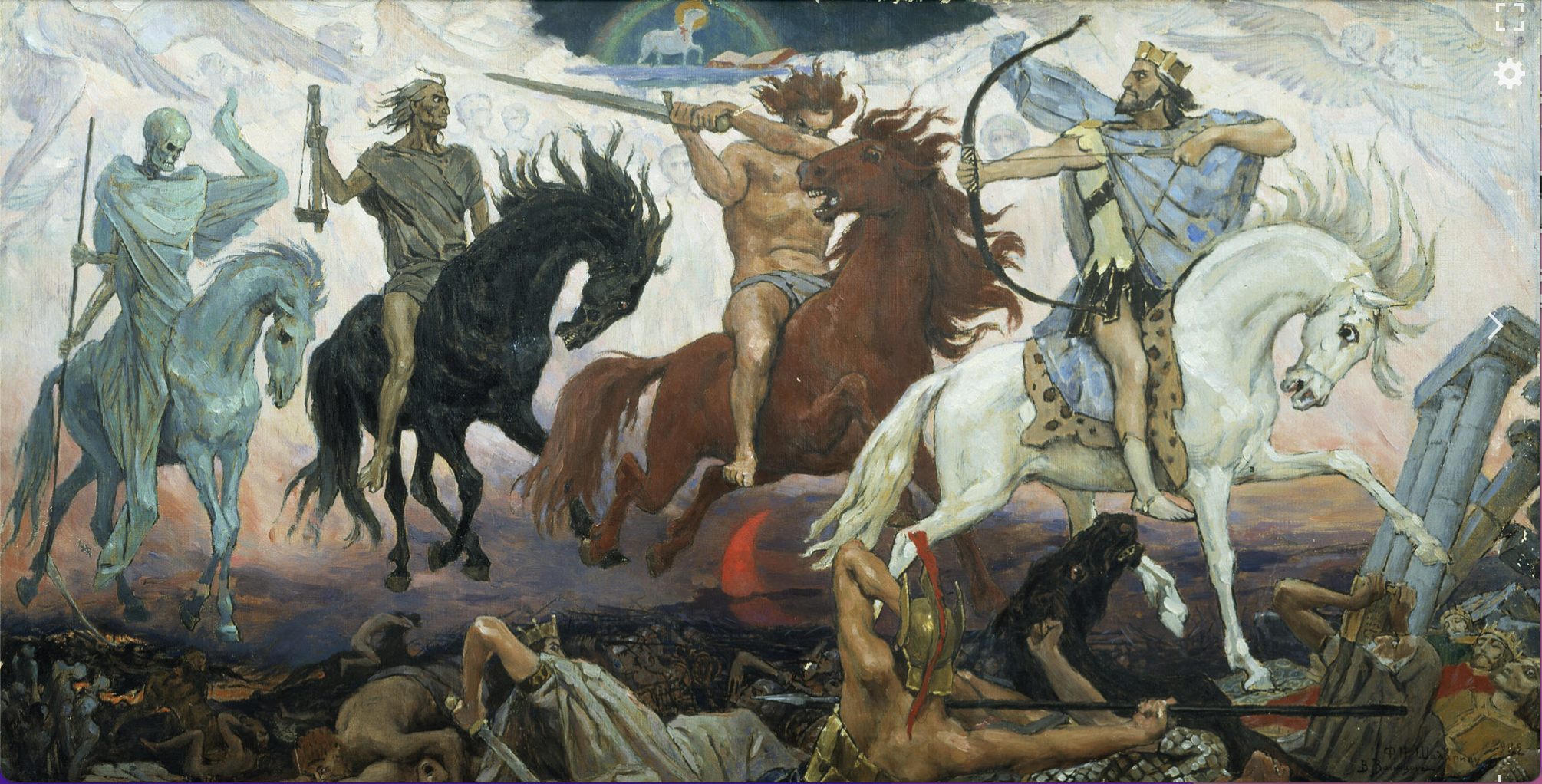
Four Horsemen of the Apocalypse by Viktor Vasnetsov (1887)
© Darius A Irani, 2026
The Search
By the end of the nineteenth century, physicists had little doubt left that mass and energy were interchangeable, and at the start of the twentieth century Einstein cemented this relationship with his pithy equation E=MC2. One wonders how famous this equation would be if C was not such a large number. Certainly, the world would be a much safer place. Sadly, for our planet, C is very large and C square is enormous. It is not rocket science to realize that if we could convert even a little M into E, we would get a very big bang. Given our perpetual hunt for more effective ways to kill each other, the search was on for a chemical reaction that would lose a little M.
Late in 1938 while bombarding Uranium with neutrons German physicists (Otto Hahn and Fritz Strassman) were surprised to find Barium amidst the Uranium. Those were innocent days, and there was a free exchange of information between scientists, and this finding came to the attention of Lise Meitner. Ms. Meitner was a German scientist who had fled Hitler’s Germany because there were traces of Jewishness in her ancestry. She and her cousin Otto Frisch – a fellow scientist – deduced what had happened. Uranium atoms had split into two smaller atoms, one of which was Barium, and the resulting mass was less than that of the original Uranium atom. She called this process ‘fission,’ and even calculated how much energy was released. It was now inevitable. Germany, Great Britainand the USA started a race to exploit this reaction and make a bomb. The start of WWII made this an almost existential endeavor.
The Race
Uranium exists as three isotopes. The most common one is the non-radioactive U238, and the rarer, radioactive and fissile U235 (there is an even rarer isotope U234.) In nature U238 is about 140 times more abundant than U235, and it would take a lot of engineering research to perfect techniques for separating U235 to the levels required to sustain a fission reaction. Further, by bombarding U238 with Neutrons, a new artificial element was produced - Plutonium 239 - which was also radioactive and fissile. So, a second project was set in place to use reactors to produce weapons grade Plutonium.
After just a short time, both the US and the UK combined their resources into a single effort – The Manhattan Project. It would take this team several years to complete the design and accumulate enough fissile material to make the first three bombs. By then Germany and Italy had been defeated and Japan was the only remaining enemy. Too late the Allies would realize that Germany was so far behind that its nuclear program had never been a threat. Had the Allies known this earlier, there was at least the hope - however improbable - that they might not have built the bomb, and our planet and species had a real chance for true world peace. But we built the bloody thing, and now psychopaths all over the world have got dozens and some have hundreds of them.
Back to WWII. The Japanese were refusing to surrender unconditionally, and the closer the allies got to the home islands, the more ferocious, fanatical and suicidal the Japanese defenders became. After the battle for Okinawa there was little doubt that an invasion of the Japanese mainland would cost hundreds of thousands of American lives and millions of Japanese lives, almost half of whom would be civilians. As cruel and callous as this might sound, the two bombs ended the war with the least number of casualties on both sides.
Initially, three bombs using two different designs were produced. The first bomb “Little Boy” was very uncomplicated and inefficient. The design was simple enough that it was not felt necessary to test it. It basically shot two subcritical masses of U235 into each other at high velocity and showered them with Neutrons. It is estimated that less than 2% of the available fissile material contributedto the resulting explosion, but efficiency was not important. It just had to work with devastating effect, and it did. It was dropped on the city of Hiroshima and produced an explosion equivalent to 15 kilotons of TNT, destroying almost everything in a half mile radius from ground zero, and killing everyone within a 1-mile radius. A good estimate of the number immediately killed and wounded is 100,000.
(Hiroshima had deliberately not been bombed until then. The Army was looking for an undamaged target to accurately assess the effect of just the bomb! This had lulled its inhabitants into a false sense of security, thinking they were not important enough.)
The other two bombs were more efficient and used Plutonium 239 as the fissile material. To verify that this design worked, one of the two was exploded at the Loas Almos proving grounds, and its brother, named “Fat Man” would be dropped on Nagasaki. Because of the geography of the region, it resulted in only half of the casualties of Hiroshima. Nonetheless, together they achieved their objective. Despite objections from the armed forces, Emperor Hirohito agreed to an unconditional surrender.
Making Like Gods
It could have ended there. It should have ended there, but human nature being what it is, it did not. Some of us were now demigods with the biggest stick in the neighborhood, and it was impossible to not use it to win arguments with our neighbors. If the stick is so big that one only has to threaten to use it, the temptation is irresistible. The problem is that the neighbors are now so irate at losing the argument without even daring to put up a fight, that they become determined to get their own even larger sticks, and the madness continues.
While the communist bloc was racing to develop their own fission bomb, the Western allies refined the size, efficiency and power of these weapons, resulting in yields ranging from 20 tons to 170 kilotons. During the cold war, thousands (not exaggerating; thousands) were manufactured and deployed in everything from artillery shells (The Davy Crocket recoilless rifle) to torpedoes and cruise missiles.
Meanwhile, spurred on by Russian developments, the demigods were aspiring to full godhood status. A second race started to utilize the very power of the stars. Could the pressure and temperature created by a fission bomb be used to fuse atoms of Hydrogen into Helium with an even bigger bang? Why not? The Gods do it in the stars, why couldn't we? And we did. We created the fusion or Hydrogen Bomb. Now, destructive power 100 times greater than that of the Hiroshima bomb was available, and our “civilization” and our spaceship home were just a small misstep away from extinction.
Compared to the destructive power of the Hydrogen bombs (strategic weapons,) the earlier fission bombs were so underpowered that they were now relegated to the secondary category of “low yield” and “tactical weapons,” more suitable to be used on battlefields, and not adequate to decide the outcome of a full-scale war. The first letter in all the acronyms for the various arms limitation treaties is always “S” for Strategic. Tactical nukes are not even counted as part of any arms limitation treaties.
It is a harsh indictment against our civilization that a weapon that merely 80 years ago was sufficient to end the greatest conflict we have ever known is now considered to be inconsequential.
The scope of our MADness
The Russians were - and still are - obsessed with size as a means of intimidation. They wanted there to be no doubt that whether via a first or second strike, in the event of an all-out nuclear exchange, Western societies would be decimated. In the 60s they manufactured ICBMs aptly named SATAN by NATO (SARMAT by the Russians.) These carried a single warhead with a yield of 18 or moremegatons.
Three factors made such a weapon impractical. Firstly, rapid advancements in computational power made the interception of simple ballistic trajectories easy. More importantly, nuclear test programs showed that the destructive power was not directly proportional to the yield. Doubling the yield did not double the area of destruction. You would need eight times the yield just to double the destruction zone, so deploying such high yield weapons was very inefficient. Finally, by carrying multiple smaller warheads you can evade interception and hit many more targets with one ICBM.
So, Russia (and the USA) developed the MIRV (multiple independent re-entry vehicles) ICBMs. These start out as ballistic missiles, but mid-flight they start spitting multiple independent warheads and decoys, each heading for a different target. Their trajectories are much less predictable, which makes them very hard to intercept.
My Stick is bigger than your Stick
Russia’s obsession with massive destructive power peaked in 1961 when they created a bomb with a potential yield of 100 MTons (the Tsar Bomba.) In a surprising show of restraint, they decided that such a large explosion might be too dangerous and lowered the yield to 50 MTons before detonating it.
Holding Hands on the Road to Hell
By 1962 both the superpowers had accumulated enough destructive power to decimate the whole Planet no matter who struck first, and the doctrine of Mutually Assured Destruction (MAD) was fashioned. Basically, if either side was attacked for any reason, the other could retaliate or escalate until both sides were annihilated, taking the whole Planet to hell with them. As we will see later, a total nuclear exchange will leave no survivors.
This doctrine achieved the pinnacle of obtuseness in 1972 with the signing of the Anti-Ballistic Missile Treaty. Its basic premise was that to avoid another weapons race, both parties agreed to NOT DEFEND themselves against the other parties' existing weapons! Each party was allowed to build a defense system to protect just one city and one retaliatory launch facility. Everything else was to be left undefended. Surviving by allowing annihilation, who knew lunatics could be so clever.
President George W Busch withdrew the US from this treaty in 2002, and the asylum doors were now wide open. The loonies were set free to find new and better ways to kill us all, and they have.
SUPERORUZHIE (Super weapons)
In March 2018 Putin announced the creation of a family of five new super weapons. The first was the RS-28 Sarmat. Intended to replace the earlier SATAN ICBM. It is a liquid fueled super heavy ICBM. Each one can carry 10 independent warheads each with a yield of at least 750KTons. A few decoys would be thrown in to make interception harder. It is estimated that 20 of these would be enough to completely obliterate the entire US. They were scheduled to enter service in 2022. A notable feature of its warheads is the use of a Fractional Orbital Bombardment System (FOBS.) In theory, these would use a low Earth orbit (about 90 miles high) and approach from over the South Pole thus avoiding the extensive detection methods pointing at the North Pole.
Unlike the ballistic and predictable trajectory outside the Earth’s atmosphere of a conventional ICBM, the Avangard Hypersonic Glide Vehicle (HGV) spends most of its time travelling at very highspeeds (about Mach 20 at launch) in the upper atmosphere. Its ability to maneuver at these high speeds may help it to evade interception.
Then there is Poseidon, a nuclear-armed, unmanned underwater vehicle (UUV). Basically, a large, nuclear powered, autonomous, and fast (maybe 70 knots – faster than anything could catch it) nuclear tipped torpedo. Because it is unmanned, it can dive to depths where manned submarines can't follow it. Some analysts suggest that depending on its yield, it could create a Tsunami about 1000 feet high and when salted with Cobalt 59 could render vast swaths of coastline uninhabitable for decades.
How many times do they want to kill each of us?
For obvious reasons the exact size of the various arsenals is a closely guarded secret, but analysts on both sides have reasonable estimates of the number of deployed and standby warheads available to Russia and the US. Remember we are only counting the Strategic (Fusion bombs) weapons. A good estimate of the total number of deployed and ready to use strategic warheads is 3,000. There are about 6,000 more that are stockpiled, but we can ignore them (for any number of reasons, after the first 3,000 have been exploded, even just finding the remaining 6,000 will be a challenge.) Keeping it simple, let’s assume each of these has a destructive yield equivalent to half a megaton of TNT. This means that when the shit hits the fan, the equivalent of about 1.5 billion tons of TNT is going to go BANG. The human population is currently at 8 billion, which suggests that on average there are 375 pounds of TNT out there with each of our names on it. Given how much damage a hand grenade can do, it would seem that 5 pounds of TNT would be more than enough to blow any one of us to smithereens. 375 pounds would blow each of us up 75 times. Do the loonies think any of us will care after the first time!

THE POLIKARPOV PO-2 - A FRAGILE LITTLE KNIFE THAT WON GUN FIGHTS
© Darius A Irani, 2024
A Chequered Career
Nikolai Polikarpov was born on June 9, 1892, in the Livensky District in Russia. His father was the village priest, and he started his own studies in a Seminary before becoming enamored of aviation and switching to the Saint Petersburg Polytechnical University, graduating in 1911. As an engineer he was a rarity in that he remained in Russia after the revolution. He would be a significant contributor to the early Russian aircraft of the 1920s, including the U-2 "crop duster," a tandem two-seater biplane designed in 1927 - 1928.
In 1928 he and his team were given an impossible task - to design a new all-wood fighter (the I-6) in an unrealistic timescale. In Stalin's demented mind their failure was no less than an act of treason and in October 1929 Polikarpov and his entire team of almost 450 staff were sentenced to death. Someone must have pointed out to Stalin that he had already executed too many engineers, and loosing so many more might cripple the Russian aircraft industry. Necessity prevailed, and his sentence was changed to 10 years of forced labor. During this time his team would successfully design the I-5, for which success he would be granted amnesty in 1931.
He went on to design the I-16 in 1933 and the I-15 in 1934. The I-16 was a revolutionary design. It was the first low-wing cantilever monoplane with a fully enclosed cockpit and retractable landing gear. It would see action against the Japanese in China, against the Finns in Karelia, and would perform well for the Spanish Republic against the nationalist forces of Franco but would eventually be outclassed by the Me 109. Still, both of them were the main Russian fighters in 1941 and would buy the Russians valuable time to rebuild their aircraft industry which was destroyed at the start of Operation Barbarossa.
For his many innovative designs and achievements, Polikarpov was awarded the Order of Lenin in 1935, and the Order of the Red Star in 1936. In 1939, he would suffer another setback when his design bureau was dismantled while he was on a trip to Germany. He died of stomach cancer on 30 July 1944.
The Little Knife
By the mid-thirties, Polikarpov would be recognized for his inventive designs, but in 1927 he was just starting out as a designer. He had only designed two earlier aircraft when he decided to upgrade the U-1 trainer and called it the U-2 (which would be renamed the PO-2 after his death.) Although it was never intended to, the PO-2 would go on to become a quintessential multi-role light bomber/ground attack/liaison aircraft that would distinguish itself in two international conflicts. It is thought that as many as 40,000 variants were manufactured up to 1960, making it the most produced biplane in history!
It is a tandem two-seat bi-plane, best described as reliable and uncomplicated. Ideal as a trainer and for short field operations. It is powered by a Shvetsov M-11D, 5 cylinder, air-cooled radial engine generating 99hp. With a max speed of 94mph and cruising at an exhilarating 68mph it wasn’t going to impress anyone, especially when in 1927 the contenders for the Schneider trophy were within spitting range of 300mph. But then, it was never intended to impress anyone and would have faded into obscurity like many of its contemporaries if Germany had not invaded Russia.
It has no brakes so taxying and stopping in short fields can be exciting. A pilot who flew it out of the Shuttleworth collection once described it as a big heavy girl with little fineness. With the bomber modifications it was quite heavy and probably required rough handling, but its slow speed allowed it to make very tight turns.
A Band of Sisters
Between the wars, Russia had an active civilian aviation program. There were an abundance of clubs and schools where both men and women had learnt to fly and navigate. Prominent among them was Mariana Roskova. Besides her accomplishments as a long-distance flyer, she had gained enormous popularity for once surviving for 10 days in the Siberian outback.
After the outbreak of war, many young girls with flying skills wrote to Mariana asking how they could contribute to the war effort. She used her influence to approach Stalin with the idea of forming all women aviation regiments. Up to then women had been banned from combat duty. However, the German invasion was bleeding Russia’s manpower, and the propaganda value of such a formation was too tempting. In October of 1941 Stalin approved the creation of three, all women, aerial regiments: the 586 was a fighter regiment; the 587 a day bomber regiment; and the 588 became a night bomber regiment. Each regiment comprised about 400 women with ages between 17 and 26 years old. They were resented by the men they worked alongside with, treated with derision, and equipped with ill-fitting clothing and outdated equipment, which might explain why the venerable PO-2 was the 588’s designated workhorse.
If it Sounds Like a Broom, and Flies Like a Broom, the Pilot Must be a ....
The PO-2’s journey from 2 place trainer/crop duster to weapon of war began in September 1941. During the defense of Odessa, a civilian PO-2 piloted by Pyotr Bevz dropped bombs on the besieging German guns. Although it made no difference to the outcome of that battle, a germ of a possibility took root. Could the PO-2 be used as a light short-range bomber?
Some modifications were necessary, including bomb carriers beneath the lower wing, some armor plating to protect the pilot and observer, and a rear facing 7.62mm machine gun in the observer's cockpit. These were approved by Polikarpov, and the light bomber variant was created. Not a lot could be done about its inherent frailty. A handful of tracer rounds was enough to set its wood and fabric fuselage ablaze earning it the Russian nickname ‘Kerosene lantern’ (‘it burned like a box of matches’). So, flying around in daytime was not an option, and the modified PO-2 was assigned to the 588th Night Bomber Regiment.
With a bomb load of about 700 pounds, the little PO-2 was not going to settle even an argument, least of all a battle or the war. However, it would have a completely unexpected effect on the German front-line troops. A typical mission would start at a field near the frontlines. The Russian women would take off after dark in formations of 2 or 3 PO-2s and fly at tree top level until they got to the German lines. One of them would then deliberately draw the German’s attention allowing the others to climb to a suitable altitude, cut their engines, glide down on the unsuspecting Germans, drop their bombs and be gone, swallowed up in the night.
The Germans could not get much rest! They would get little or no warning. All they heard was the whistle of the wind through the rigging of the PO-2, and then the bombs would fall. It was galling enough that a bunch of women were making their lives miserable, doubly so because they could not do much about it. It was very hard to find a PO-2 skimming the trees in the dark. Even years later, despite the advent of airborne radar, the wood and fabric construction did not lend itself to detection. If found, it was even harder to get a bead on them. The max speed of the PO-2 was less than the stall speed of the Me 109. If the PO-2 was ambling along at its cruise speed, the Germans would barely get it in their sights before they flew right past it. It was so challenging that any German pilot who shot down a PO-2 was automatically awarded the Iron Cross.
Somehow, the frustrated and sleep deprived Germans became convinced that the sound of the gliding PO-2 was exactly that of a witch riding on her broom, and the legend of die Nachthexen (The Night Witches) was born. Far from being offended, the Russians welcomed the moniker, and it stuck. The regiment flew its first mission on June 28, 1942, and would see action from the Ukraine to the bitter end in Berlin. At its peak it comprised about 40 2-person flight crews who would display incredible stamina and bravery.
Each mission would last between 45 minutes to an hour. Altogether they would fly over 23 thousand of them. Some of the crews flew over 800 missions, and one pair spent a long Russian winter night flying an incredible 18 missions (Yekaterina Ryabova and Nadezhda Popova). The women did not even leave the cockpit, they just sat there sipping tea while the PO-2 was re-armed and re-fueled.
Flying in an open cockpit during the brutal Russian winters was demanding and dangerous. Bare hands would freeze to any metal they touched. They flew so low that a parachute would have no time to deploy, so they were not used till very late in the war. They flew from fields very close to the front lines and used no radios. Sometimes the Germans would recapture the field they had taken off from, which resulted in a very unwelcome surprise when they tried to land. The PO-2 was often described as a coffin with wings. Still, the witches would drop over 3,000 tons of bombs and 26 thousand incendiary shells.
Eighteen pilots and six navigators were awarded the title Hero of the Soviet Union, and collectively they would emerge as the most highly decorated female unit in the Soviet Air Force. Their founder, Raskova, would die in 1943 on her way to the front. Another 30 would die during the war. Their last flight was on May 4, 1945, three days before Germany surrendered, and less than 40 miles from Berlin. Ironically, they and the PO-2 were excluded from the big victory parade because the PO-2 was supposedly too slow.
Molon Labe
Apparently, the end of World War II was not the end for the PO-2. Half a world away a new war and a new enemy put it back to work. The North Koreans had quite a few of them and caused a lot of damage to UN bases in night raids like those of the witches. On one raid a single PO-2 dropped fragmentation bombs on a line of P-51 Mustangs damaging eleven of them. Three of them were so badly damaged that they were later destroyed. In mid-June 1951, Suwon Air Base was attacked by a pair of PO-2s. One F-86 Sabre was set afire and eight others were damaged. Only quick action by the ground crews prevented the situation from getting out of control. The UN forces had their own nick name for the PO-2: Bed check Charlie. The difficulties in finding and destroying the PO-2 had not diminished. If anything, the newer Jet Fighters had an even harder time slowing down to a suitable interception speed. U.S. Korean war veteran Leo Fournier summed it up in his memoirs: “... no one could get at him. He just flew too low and too slow...”
However, it was not all one sided. There are two recorded instances where American pilots brought down PO-2s. On June 16,1953 a USMC AD-4 piloted by Major George Linnemeier with Vernon Kramer in the CWO seat shot down a PO-2. Now retired, Col. Richard Heyman also brought one down in his A-26 Invader. The little PO-2 wasn’t without its own victories. A pilot in a Lockheed F-94 Starfire was tempted to go after one and tried to slow down to match its speed. The stall speed of the F-94 is about 130mph so it's not hard to guess how that ended. This would earn the PO-2 the unique distinction of being the only biplane credited with downing a modern jet fighter. Leonidis’ ghost is probably chuckling over that one.
NOTES:
The success of the Night Witches prompted the Germans to create their own harassment units using their equally obsolete 1930s open cockpit biplanes!
The Soviets were well aware of the consequences of sleep deprivation. It was frequently used by their secret police against political prisoners.
The Shevtsov was eventually upgraded to 125 HP. Still, when fully loaded with bombs, ammo and two crew members its takeoff weight was close to 3,000 pounds and it would be a struggle to cruise faster than 60mph.
Some sources say that the witches cut their engines and others that they idled them. Could one hear the sound of the wind in the rigging if the engine was idling – not sure! However, the PO-2 had no electric starter – starting on the ground requiring compressed air. So, starting mid-air would require them to get the prop windmilling in a dive.
Sabaton is a Swedish heavy metal band that focus on wars and acts of heroism. The have written a stirring tribute to the Night Witches. It is available on YouTube and is worth listening to:
“...Canvas wings of death
prepare to meet your fate
Night bomber Regiment.
588...”

A SENSE THAT CONNECTS US ALL
Pte. James Brown was a driver at the Head Quarters of the 1st Battalion, North Staffordshire Regiment (AKA The Prince of Wales Regiment). In 1913 while serving in Co. Cork he formed a strong bond with a shaggy haired Irish Terrier puppy who he named Prince, in keeping with the regiment’s name. Prince soon became a regimental groupie and would often accompany the men on their marches.
© Darius A Irani, 2022
Private James Brown was a driver at the Head Quarters of the 1st Battalion, North Staffordshire Regiment (AKA The Prince of Wales Regiment). In 1913 while serving in County Cork in Ireland, he formed a strong bond with a shaggy haired Irish Terrier puppy whom he named Prince, in keeping with the regiment’s name. Prince soon became a regimental groupie and would often accompany the men on their marches.
Shortly afterwards, when Brown returned home to his wife in Hammersmith, London, Prince went with him. In August 1914, Brown and his regiment were shipped off to Flanders on the Western Front. On September 27 Mrs. Brown noticed that Prince was missing. She was so distraught that she even reported it to the Police the next day. In reality, Prince was neither lost nor stolen. He had instead started on an epic journey to reunite himself with his beloved master. Prince first made his way to one of the channel ports, probably Southhampton. Having got there one would think that the English Channel would have been an impossible obstacle - but not for Prince. He attached himself to some troops, used them to sneak aboard a troop ship, and arrived on the mainland.
Now he was truly a stranger in a strange land. None of the sights, sounds and most importantly the smells, would have been familiar to him. Yet he seemed to know exactly where to go. He was initially spotted in Armentieres just west of Flanders. He then turned left and headed for Flanders. As he got closer to the front lines, the sounds and smells of the battlefield would have been almost unbearable, but he just kept going until he got to the trenches themselves. A member of the regiment recognized him and took him to James. On November 26, almost exactly two months to the day that Prince had “disappeared,” Mrs. Brown received a letter from her husband. It included the following text:
“…I am sorry you have not found Prince, and you are never likely to while he is over here with me. It is a very strange thing I should have got him. A man brought him to me from the front trenches. I could not believe my eyes until I got off my horse, and he made a big fuss of me. I believe he came across with some other troops. Just fancy him coming here and finding me. He is quite settled down with me, and I have made him a coat out of some of our old great-coats, which will keep him warm. He is the pet of the Regiment…” (wartimememoriesproject.com)
Within a couple of days, the story of this “miraculous” journey was in almost every newspaper in the country, and came to the attention of the RSPCA. They thoroughly investigated the matter and concluded that it was undeniably true. Prince had travelled over two hundred miles, including crossing the English Channel, and unerringly found his master near the trenches of the Western Front. Prince became the mascot of the regiment and adapted to life on the front. He could sense when a large artillery shell was approaching and would scoot off and hide. James and Prince remained in Flanders until the Armistice, surviving some of the bloodiest battles of the war (Passchendaele, Vimy Ridge, Messines and Cambrai). The war must have taken a toll, because Prince died in 1921 at the relatively young age of eight(1).
Although Prince’s journey was remarkable, it is by no means unique. Dr. Rupert Sheldrake is a world-renowned biologist. He spent many years conducting thousands of interviews with pet owners and others working with animals, and wrote a book about this strong - but little understood - bond between animals and humans(2). And it is not just dogs: cats, parrots and even horses have exhibited similar behavior. Sadly, this bond appears to be only one-sided. Our five senses, as valuable as they are, cannot even help us to find a lost pet that is barely two miles away. We have to resort to stapling pictures to telephone poles. Clearly, there is a Sixth sense that animals like Prince can tap into, which is as accurate as any modern GPS system and even knows whether the target is alive or dead.
Lawrence Anthony was the long-standing head of conservation at the Thula Thula animal reserve in Zululand, South Africa. He had a legendary ability to work with, and calm wild elephants. So much so that it earned him the moniker of “Elephant Whisperer.” In 1999 he received a call about a dangerous herd that was about to be shot unless he took them into the Thula Thula reserve. The herd was violent and had escaped from various other enclosures. Nana, the matriarch, hated being confined and hated humans for confining her. She had acquired a few tricks for breaking out of enclosures with high voltage fencing. Sometimes she would deliberately suffer the 8,000 volt shock and push through the pain just to be free. Her current owners were ready to shoot the whole herd if they could not be contained. Remaining within the confines of Thula Thula was their last chance of staying alive.
Lawrence describes an early morning encounter with an enraged Nana who had a baby in tow and was ready to break out. Because of the baby, this was about as dangerous a situation as Lawrence could find himself in. The only thing between them was the 8 foot high electric fence that had no hope of stopping a determined Nana. As he stood pleading with her on the other side of the fence, with both their lives hanging in the balance, he felt a connection. Without any apparent understanding of the pleading words that Lawrence was calmly speaking, Nana somehow realized he was a friend and savior, and she and her herd melted into the bush.
Lawrence’s reputation spread, and more problem elephants were sent to him forming a second herd on the reserve. Lawrence then turned his attention to the plight of the Northern White Rhinoceros, who were on the verge of being exterminated in the DRC. He had planned a fund raising gala dinner late in March 2012 and was preparing for it when he suddenly died of a heart attack on March 2.
Within hours, both herds started a journey of 12 hours to return to the home of the man who had saved them. They had not been anywhere near the property for a year and a half. Could it be just a coincidence that both herds chose that precise time to come back? Having returned, both herds simply milled around the property for two days, in apparent vigil, and then dispersed again. Clearly, they had sensed Lawrence’s death and had returned to pay homage to the man who had saved their lives(3). What is more astounding is the report by ‘World of Buzz’ on November 27, 2019 that the herd had been returning on March 2 for the past Seven years!
This ability to sense and find death, as well as life, is also well documented. There are numerous cases of dogs who go missing and are found at their master’s graveside even though it was many miles away, and they had never ever been anywhere near the cemetery.
It would seem that there is something out there we do not comprehend. Let us call it Nature. It seems to know exactly where we are and whether we are alive or dead. Animals like Prince and Nana are able to tap into this information via a sixth sense that humans do not possess. There is some evidence that we too were once capable of interacting with this medium. However, with our increasing reliance on language and technology, we have lost touch with this primal connection.
In two previous essays, the historical behavior of pathogens suggested that Nature might be sentient, but it was not clear how. Here then is evidence of its awareness. Nature knows who is alive and who is dead, who needs to live and possibly who needs to die.
NOTES:
1. The Wartime Memories Project - The Great War
Pte, James Brown British Army 1st Battalion North Staffordshire
2. “Dogs That Know When Their Owners are Coming Home”
Dr. Rupert Sheldrake. Three Rivers Press.
3. “The Elephant Whisperer” By Lawrence Anthony and Graham Spense

BAD THINGS ARE HAPPENING MORE FREQUENTLY
Copyright Darius A. Irani,2023
Most pathogens are designed to be killing machines and have been around for thousands of years. So, it is interesting to study if their frequency and behavior changed as our population changed. However, understanding their impact on human society had to wait until men started keeping a record of these events and how they had shaped their lives. The earliest such record is during the siege of Jerusalem in 701 BCE. In the intervening 2,700 years there have been close to 100 recorded events of epidemics and pandemics.
In the early years knowledge of medicine was almost nonexistent. Trying to diagnose what a pathogen might have been based on the descriptions provided by laymen almost three millennia ago is challenging. Thankfully, there are many modern scientists who have devoted much effort to analyzing the documented symptoms and providing a best guess as to the nature of these killers. Equally important is a parallel body of research that provides us with estimates of changes in the world’s population during this period. So, finding such a correlation, if there is one, is possible.
However, as one digs into the available data, one realizes that we are dealing with something much more complicated. Not only is there a correlation between the frequency of the pathogens and the growth of the human population, but we also see four other traits: some pathogens exhibit a singularity of purpose; some an ability to go dormant, when necessary; some have a subsequent influence on the course of history far out of proportion to the impact of the pandemics themselves; and, some display an ability to adapt to our defenses and to evolve into lethal variations. When looked at holistically we are tempted to question the very nature of Nature. Is Nature just a benign aggregate of all living things around us? In which case these events are random and accidental. Or, is Nature far more complex? Potentially even sentient. If so, with what ultimate purpose?
(At the end of this essay is an Xcel spreadsheet. It contains a list of all the known pandemics/epidemics, their date and possible nature of the pathogen.)
CORRELATION or COINCIDENCE
Our population increase has not been a gradual linear process. Instead, it has been periods of exponential growth. Our span of 2,700 (701 BCE to modern times) years can logically be broken into three eras for deeper analysis.
E1: 701 BCE to 1499 CE (2,200 years) The world’s population grew from 75 million to 450 million. A very modest average of less than 200,000 per year. There are only 11 recorded events. Three were smallpox, five were the plague (Yersinia pestis), and three are not fully understood. This averages out to one event every 200 years. During this span, our knowledge of medicine was limited. We did not know what was causing these illnesses or how to stop them, so they were able to run rampant until they petered out on their own. The most devastating pandemic ever recorded occurred in this era. The Black Death of 1347 – 1351. It is estimated that as many as 150 million died during this single event.
E2: 1500 CE to 1899 CE (400 years) We transition from the Middle Ages to modern times. There was an explosion in both the world’s population and in international exploration. The population tripled to 1.6 billion. This is an average increase of four million every year. The number of pandemics also tripled to 37. We are now looking at a major event about every eleven years, or twenty times more frequently than in E1. The bacterias dominate for the last time with 26 events. The nature of the bacterium changed abruptly in 1816 when the old reliable plague had run its course and was replaced with cholera (more on this later). Smallpox starts to emerge as an efficient killer worldwide. Many sources suggest that in 18th century Europe it killed about 400,000 every year, and 500 million in the century preceding its extinction in 1980. Its spread worldwide can be directly linked to human exploration and colonization. Indigenous peoples in America and Australia had no resistance to it and were decimated, allowing for easy conquest.
E3: 1900 CE to 2020 CE (120 years) The human population now increases 5-fold to 7.8 billion. This is an astounding rate of 65 million per year, or 185,000 more births than deaths every day. The attacks keep pace with 44 events, about once every two and a half years, or four times as frequently as in E2. The numbers do not lie, bad things are happening more frequently, and in direct correlation with our population increase.
This was an egregious and selfish increase. No other species could sustain such an expansion. There is simply not enough space or naturally occurring food on the planet. Humans, however, have been endowed with some unique skills. We are the only species that can grow our own food and mold our environment to suit our needs. We can expand into areas we were not adapted for by building shelters and controlling their environments to keep us comfortable. This, together with advances in medicine and agriculture, has enabled us to not only sustain this population growth, but to continue to increase it.
This population explosion is even more astounding when one considers the travesty that was the 20th century. It was a time full of anguish and despair. A total of 51 wars and 50 genocides would take 250 million lives. Pathogens would kill at least another 86 million. Many millions would be forced out of their ancestral homes and become permanent refugees in squalid camps. Yet, our need to procreate is apparently so primal that despite the uncertainty and even depravation of the basics of everyday life - or maybe because of it – we accelerated headlong down the path of geocide and self-destruction.
Such an expansion is not without a price. As the need for arable land increased, we started burning down our forests and woodlands. The other species that called these spaces their home were pushed out and started dying off. And, when the land was not enough to sustain us, we started denuding the oceans and polluting them. This is madness. We live in a spaceship. Everything we need to survive must come from within the ship. Just because we can grow our own food does not mean we can also provide the other prerequisites for life. For example, we cannot produce more Oxygen. There is ONLY ONE way in which our planet’s Oxygen is replenished. That is through photosynthesis in trees and through organisms in our oceans. Between deforestation, our population explosion and our dependency on combustion for providing energy, we are already seeing a steady decline in the level of atmospheric Oxygen. The end will not come for many generations, but when it does it will not be pleasant.
WHY ONLY US – A JUSTIFIED PARANOIA
As organisms go, viruses are very primitive. They do not even meet the accepted criteria to be called living. On their own they are ineffective and die after a brief lifespan. However, lodge them in a host and there is no stopping them. They will take over the resources of the host and multiply until they kill the host itself. Smallpox, Polio, and Measels are three of the most prominent of the historic viral killers. They also have something in common. They are all non-zoonotic. They have NO OTHER hosts in nature. Even our nearest relatives - chimps - cannot host them.
Cholera is a bacterium. It does not need a host to survive. It is alive in its own right. Starting in the latter half of the 19th century, it replaced the plague as the dominant bacterial killer. It too very rarely affects any species other than humans. There is no known insect vector for it, and no animal reservoir has been found.
There you have it. Four of the most prolific killers of all time have only ONE purpose. To maim and kill humans!
At some level this either makes no sense or poses a profound question. There was no evolutionary advantage for these viruses to restrict themselves to just one host – especially a host that lives in well-defined spaces. In fact, it is a death sentence. We discovered vaccines for all three viral killers, isolated humans who were infected, surrounded them with a ring of vaccinated humans and strangled the viruses into extinction. This would have been impossible if they had been zoonotic.
Smallpox has been around for thousands of years. It has killed millions of our species by making billions of copies of itself in its hosts. All this multiplication, and not a single mutation!! Compare it to Covid-19. In just three years we have seen over a dozen mutations, and they keep on coming. Modern estimates are that humans and chimps (and bonobos) have 98.7% of their DNA in common. All it would have needed was a small, fortuitous change, a minor alteration and smallpox could have jumped to a primate and still be around. But no. Whatever created it gave it strict instructions. You can ONLY kill humans. You cannot infect or harm ANY OTHER living creature. What then created such a killer, and why? If we can ever answer this question, we may have taken the first step in understanding what we are and why we are here.
AN INCOGNITO JOURNEY
Smallpox is an old-world disease. The early Spanish explorers brought it to the new world. In 1520, barely 20 years after Columbus landed on Hispaniola the first recorded pandemic would kill about 8 million in Mexico. Its journey across the Atlantic poses a conundrum. In those days, Spanish ships would leave the mainland and stop at the Canary Islands to replenish before starting the crossing. From there it would take about 35 days before landfall in the West Indies. Because it is non-zoonotic, the carrier had to be a crew member. It usually took 10 days after infection for the first symptoms to emerge. Even if he had been infected on the last day before leaving the islands, barely a third of the journey would have been completed before he showed symptoms and became infectious himself. In the cramped quarters of the ships of that time, the disease would have ravaged the crew. Yet, they appear to have arrived safely and mingled with the local population before the disease started its killing. This raises alarming possibilities. Can Smallpox can go dormant? Current thinking is that there are five viruses that can go dormant, but Smallpox is not one of them. If it did not go dormant then how did it cross the Atlantic? Might it actually be Zoonotic and we just don't know what the host is? Neither of these possibilities bode well for our species.
This could also be a warning to us that we are just one big, connected tribe – even more so now. There is nowhere we can go that is beyond nature’s reach. It did not need an intercontinental jet that could cross the Atlantic in eight hours. Just a small wooden boat propelled only by wind and sail was more than enough.
DECIDING BATTLES AND CHANGING HISTORY
Our perpetual belligerence and resulting wars - which are also well documented – have often played into the hands of these killers. Battlefields are a fertile breeding ground for pathogens. The weary survivors are easy prey for these microscopic predators, becoming unsuspecting carriers for spreading the diseases on their trek back to their homelands. In many cases, these pathogens have altered the course of a struggle with unforeseen consequences for years to come.
The earliest known record is during the siege of Jerusalem in 701 BCE by King Sennacherib of Assyria. It is referenced three times in the Bible (II Kings 18 & 19; Chronicles 32; and the Book of Isaiah 36 & 37.) “For I will defend this city to save it for mine own sake, and for my servant David’s sake. Then the angel of the Lord went forth, and smote in the camp of the Assyrians ….” (Isaiah) The implication is that God saved his people by infecting the Assyrians with some fatal disease. A more likely explanation is that the water wells outside the city walls had been deliberately poisoned. Whatever the cause, the Assyrians had bigger fish to fry and decided to move on from this place of death and pestilence. Thus, sparing Jerusalem and its fledging new religion, Judaism.
Sennacherib had no idea that this decision to spare Jerusalem would be one of the most important turning points in history. Had the Assyrians prevailed, “...Judaism would have disappeared from the face of the earth and the two daughter religions of Christianity and Islam could not possibly have come into existence. In short, our world would be profoundly different in ways we cannot really imagine.” (Infectious Alternatives by William H. McNeill)
The very next recorded epidemic is the Athenian plague of 430 BCE. It struck in the second year of the Peloponnesian war, when Athens was under siege and seriously overpopulated with refugees. The pathogen would decimate about a quarter of the city's population - about 75,000 - and was a significant contributor to its eventual defeat.
Early in 165 CE the Romans launched a military operation against Parthia. The returning troops brought Smallpox back with them. What followed was the first recorded pandemic. The effect on Rome was so devastating that it is thought to have created the conditions for the decline and ultimate fall of the Roman Empire. The ultimate killer was the plague/Black Death (Yersinia pestis). It coincided with the start of the 100-year war between England and France. Between them they had allies from 12 other European regions. Given the extensive breeding grounds, multiple carriers, and long journeys home, it would be the greatest killing event in all recorded history. Estimates of the number of dead vary from 75 million to 200 million.
ADAPTING TO OUR DEFENSES
Until the early 19th century, the dominant bacterium continued to be Y. pestis. Although the root cause of the plague would not be discovered until 1894, Europeans had realized as early as the “Great Northern Plague” of 1700 that separation of the sick from the healthy was the only way to contain this killer. Infected locations would be sealed off by ‘cordons sanitaires’ and the infected would be quarantined in plague houses. By the time of “Caragea’s plague” in 1813, Y. pestis’ ability to spread and kill was being severely curtailed.
Nature responded by coming up with a new killer. Gone now were the clearly recognizable buboes. Rats and fleas were no longer relevant. Nature started using water - the most essential of our nutrients to kill us. During the 19th century, cholera would break out in the form of six pandemics. It was so contagious that outbreaks that started in India would within a year spread throughout Europe and Asia. The timing of these outbreaks is enigmatic. Cholera is borne out of poor sanitation resulting in unsafe water and food. It would seem more likely that the Middle Ages, with their significantly poorer living conditions, would have provided a better breeding ground for such a pathogen. Yet it is conspicuously absent until the 19th century. It is almost as if Nature was hiding Cholera up its sleeve, waiting for Y. Pestis to run its course before unleashing it!
There are only two strains of cholera. The “classical” variant, and the modern version called El Tor. Both have existed in the waters of the Bay of Bengal for thousands of years. Yet, as we have seen, the classical version only became active late in the 19th century. Once it started, it remained unchanged, and spent the next 150 years emerging from the Ganges Delta at will to kill humans. Eventually, the advent of antibiotics would limit its mortality, though it still emerges in poor or war-torn countries where for obvious reasons sanitation has broken down. Late into the 19th century scientists began to recognize the efficacy of antibacterial chemicals and in 1928, with the discovery of penicillin the bacterial killers start to fade away. Eventually even smallpox was eradicated. Our planet was now facing a double threat: the human population was growing out of control and the ancestral killers that had served nature for centuries were now ineffective. So nature has now turned to a new class of pathogens – the Zoonotic viruses.
THE ZOONOTIC AGE
Because they are zoonotic, they cannot be eradicated. We cannot kill every host living in the wild. It is neither possible nor practical. Being viruses, we have no broad-spectrum antidotes like antibiotics. Each one needs a specific vaccine to control it. Within their hosts, they are free to mutate. Even a small mutation could render an existing vaccine useless. Our only remedy is to stay on top of the mutations and limit their damage. Then there are the anti-vaxers...
Humans started the 20th century with a catastrophe called WWI. Not to be outdone, Nature had its own calamity in store for us - the flu pandemic of 1918. It is thought to have started at Camp Funston in Kansas – the location of the first registered case – and then spread to Europe as thousands of US soldiers were deployed to the war zone. Initially it looked just like a virulent strain of the seasonal flu. By the spring of 1918 over half of the British and French troops living in the squalid cramped trenches of the Western front were infected, but not killed. By August 1918 it looked as though it had run its course. Sadly, this was not so. Somewhere in Europe it evolved into something so lethal that it could kill perfectly fit young humans within 24 hours of being infected. Before it finally petered out it had infected about a quarter of the world's population and killed as many as 50 million.
We will see this trio of dangers repeated in all the zoonotics: they are impossible to eradicate; once infected they can rarely be treated with any medication; and, to stay alive, they will evolve faster than we can keep up. Influenza type A variant H1N1 which was responsible for the outbreak in 1918 continued to evolve and circulate for the next 100 years. H2N2 emerged as the Asian flu in 1957-58, H3N2 as the Hong Kong flu in 1968-70 etc. Then, suddenly in 2009 it evolved into something quite different. Existing flu vaccines were ineffective in treating this new variant, and the result was a pandemic that may have killed as many as 500,000 worldwide.
In 1976 a new virus emerged from Africa – Ebola. It had remained hidden in the back waters of the Ebola River for 10,000 years. Its natural reservoir is suspected to be fruit bats which do not appear to be affected by it. Like smallpox and cholera, it almost exclusively targets primates, so it was primed to jump to humans. As our population mushroomed, our need for arable land and protein also increased. We went on a binge of deforestation and consumption of wild meat. This took us deeper into places we were probably not meant to go to. Someone ate an infected monkey, and Ebola jumped to humans.
It is a hemorrhaging disease. The Zaire variety has a mortality rate of over 80%, and death is a very bloody affair. The only reason it is contained is that transmission is not easy. It can only be spread by close and direct contact with an infected person’s bodily fluids. If it was any more contagious it would be the perfect killing machine.
AIDS emerged in 1981 and is still lurking. Its transmission is about as difficult as that of Ebola. Yet, Ebola has remained confined mostly to the African continent and the total number of deaths attributed to it are about 15 thousand, whereas AIDS has spread worldwide and is responsible for over 32 million deaths. Hmm.
This brings us face to face with THE zoonotic of our time – COVID 19. Like the other killers, the family of Corona viruses has been around for thousands of years. They all start out feeling like the common cold, but at least three variants are fatal to humans. The first is SARS CoV-1. It emerged from China in 2002. Its weakness was that it was not contagious during the incubation period, only after symptoms emerged. Thus, it was easy to identify and isolate the infected and prevent its spread. It only killed about 800 and was thousands of miles away, so we ignored it. Next came MERS-CoV in 2012. It jumped to humans from camels. It had a worrisome mortality rate of 35%. Because of the limited interaction between humans and camels, it could not get a large base of victims and petered out.
COVID-19 is the name of the disease that is caused by the SARS CoV-2 virus. It evolved from a pathogen that infected just a few thousand in 2002 (SARS CoV-1) to a pandemic that by 2022 had infected over 51 million worldwide and killed over one million. It is still around, evolving at a steady pace. It is zoonotic, so eliminating it is impossible, and every single host, both human and nonhuman, is a factory where random mutations are constantly occurring. We cannot control them or their effect on us.
There is no fairy tale happy conclusion here. The evolutionary trend does not end in some kind of peaceful coexistence between host and killer. The viruses want to live just as much as we do. They will constantly strive towards greater virulence. This ensures the largest number of hosts, which in turn provides the greatest number of factories churning out copies and mutations. We cannot afford an isolationist attitude. In the current age of jet travel, we are just one big, connected tribe. A virus that killed 800 Asians half a world away evolved into something that killed over 230,000 of our friends and families, on our doorsteps, just a few years later. If we had not ignored it in 2002 then we could have been ahead of the game with a vaccine when it got to our doorstep. The enemy is relentless and has an evolving arsenal that we can barely begin to comprehend. Denial and complacency will play right into its hands.
THE CONUNDRUM THAT WONT GO AWAY
Fast forward to September 2024. After 25 years, Polio has emerged in the war torn Gaza Strip. What has it been doing for all this time? It is a virus, so it must have a host to survive. It is non Zoonotic so the host can only be one of us. This leaves us with three alternatives:
Somewhere in Gaza - about the most densly populated place on Earth - an unfortunate family has for two and a half decades sheltered members who were infected with Polio. Within this family the virus has stayed alive with no one finding out about it, and no medical help being given to the victims. Hmmm!
The virus has somehow gone dormant waiting for just the right opportunity to wake up. What does it even mean for a virus to go dormant? It would require acquiring a human host and then suppressing its primal genetic disposition to multipy and kill. Polio, like Smallpox, is not one of the five viruses that we know can go dormant. However, if it could go dormant, the current war torn environment would be the perfect time to wake up.
Finally, we have to consider that our assumption that it is non Zoonotic is incorrect. Somewhere in Gaza it found an alternate host and stayed alive waiting for what it knew would eventually happen. As we have done throughout our history, we started killing each other again.
Either alternative 2 or 3 would also explain how smallpox crossed the Atlantic ten centuries ago.


November 11, 1918. 11:11:11 am
… If ye break faith with us who die
We shall not sleep, though poppies grow
In Flanders fields.
In Flanders Fields by John McCrae
© Darius A Irani, 2023
A CALLOUS ENDING TO A POINTLESS WAR THAT FAILED TO END ALL WARS.
WWI was touted to be the war that would end all wars. For such a noble endeavor the youth of Europe enlisted in their thousands and died in hundreds of thousands. If they had known then what we know now, from Ypres to Belfort they would have cursed the instigators of this mindless slaughter with their dying breaths. Barely twenty years later we would start the killing all over again – this time on a scale that would dwarf their 18 million dead.
Early in October 1918, Ludendorff knew that Germany had lost, yet he prolonged the slaughter for five more weeks, hoping to gain some advantage in the armistice negotiations. The fact that another half million would die did not seem to bother him at all. The final act of cruel indifference would last for six hours. Germany signed the armistice at 5:12 am on November 11th. For all intents and purposes, the war should have ended right then. However, the armistice would officially not begin till the eleventh second of the eleventh minute of the eleventh hour of the eleventh day of the eleventh month, and no one saw fit to tell this to the troops who kept on shelling and killing each other for another six hours, during which another 2,738 men would die. So much for the war to end all wars!
In America, this day is recognized as Veterans' Day, whilst in Europe it is Remembrance Day. For over a century we have commemorated this anniversary with laying of wreaths, solemn ceremonies and moments of silence – all of which have accomplished nothing concrete towards the final peace that WWI was supposed to accomplish. Here we are a hundred years later, and all it takes is a vicious dictator with nuclear weapons and a Veto, and both NATO and the UN are helpless to stop him. Meanwhile, the poor dead in Flanders fields are still waiting for some peaceful sleep.

DOES LIFE SMELL?
Penny Lane having a bad hair day
© Darius A Irani, 2023
AND OTHER STRANGE QUESTIONS!
In the wild, many species spend their entire lives in tight knit groups and stay within well-defined territories. Within this space their group teaches them what food to eat, and how to find it. They also learn where to find water and shelter. Even animals that migrate over long distances usually follow the same path and the young learn by copying the elders who have done the journey before. None of this education is available to a domesticated dog. It barely gets to open its eyes before it is snatched away from its mother’s nurturing bosom and shipped off to a human family who could be hundreds of miles away for all it knows. Nothing prepares it for the sights, sounds and smells it will encounter in its new home. Yet, the dog adapts. Most importantly, it knows what it should and should not eat in a world full of alien smells. How does it know this? We believe that a dog’s primary interface with its environment is its sense of smell, and have devoted much research to the mechanics of smell. We can estimate that a dog’s sense of smell is thousands of times better than ours, but do we know what it is that they smell? And, can their noses detect something other than just chemical compounds?
Penny Lane is a Shihtweiler, a little girl with a big identity crisis. She is convinced that she is a 90 pound Rottweiler cleverly disguised to look like a nine pound Shih Tsu. Her attitude to the world around her is consistent with this grand delusion: if it moves attack it; if it is alive kill it; if it smells good eat it; if bored because nothing is moving, take a nap. Things are bound to be more interesting when she wakes up.
Last fall a leaf happened to be drifting across the back yard. To most dogs, motion is synonymous with life and prey, so Penny took off full tilt and pounced on it. What happened next was interesting. She took one sniff, realized it was not alive and immediately lost interest in it. On a typical walk she encounters millions of such leaves - same size, same shape and same color - and pays no attention to them. So it was clearly the motion of this leaf that launched the attack. How was it that with a single sniff she was able to decide that the leaf was not alive? Here is where it gets interesting. One cannot make a decision based on a single piece of data. To make a decision one needs at least two bits of information. So what was the second bit of information in her brain? Something that told her that ‘life’ had some property X and the leaf did not have this property so leave it and move on!
One possibility is that her chestnut sized brain contains a complete data base of the smell of every living creature she might ever encounter, so she can compare and discard as necessary. However, to have inherited such a list in her genes would require that her ancestors had, at some point, collectively encountered the smells of every living creature and stored them away for future generations to use - extremely unlikely. Another possibility is that all living creatures have a generic smell that identifies them as animate and vital, begging the question “Does Life Smell?”
On the other hand, it might not even be a smell that she was sensing? Basic Physics provides a very plausible proof that all moving creatures are surrounded by an electro magnetic field. Their “Aura,” or Chi/Ki in the Chinese and Japanese traditions respectively. Good Reiki practitioners can routinely connect and channel an individual’s Ki. What if dogs can also sense this Ki and use it to determine if something is alive or not? We could go even further and speculate that a universal force like Nature can also tap into this Ki to know where we are and whether we are alive or dead!
Sadly, although such a theory explains some of the phenomena, it still leaves many questions answered. For example, what happens to a chicken’s Ki after it has been killed and then boiled in water. To Penny, this is a scrumptious treat - why? What is she sensing that makes it palatable? What about processed foods like cookies which were never alive? What tells her that it is ok to eat them? Some experts argue that most dogs just grab at everything and worry about sorting it out later. Even if this were so, it merely pushes the decision from a very sensitive nose to a much less sensitive mouth. Moreover, in all the time I have known her, Penny has NEVER allowed anything to enter her mouth before first smelling it and satisfying herself that it is edible. Clearly, there is a lot left for us to understand about canine behavior and how they interact with the world around them.
COVID-21
The historical behavior of Pathogens should have left little doubt that COVID-19 would mutate into either a more virulent or more fatal version. Now that the more virulent COVID-20 (if you will) mutations have emerged, we need to look ahead and guess at what 2021 might yield. There is a very real possibility that a new variant will emerge that is resistant to the current vaccinations.
© Darius A. Irani, 2021
The historical behavior of Pathogens should have left little doubt that COVID-19 would mutate into either a more virulent or more fatal version. Now that the more virulent COVID-20 (if you will) mutations have emerged, we need to look ahead and guess at what 2021 might yield. There is a very real possibility that a new variant will emerge that is resistant to the current vaccinations.
COVID-19 has been evolving almost since its emergence one year ago. This is normal behavior for all living organisms, and up to recently these variations were minor and did not raise any red flags. Suddenly, in September it evolved in the UK into something more virulent. It could be just a coincidence that the Oxford group had started their Phase II/III trials two months earlier by involving over 12,000 participants. Alternatively, it is possible that the virus sensed the noose closing around it and took the first step necessary for it to survive. The virus wants to live, the vaccine is designed to strangle it. Survival depends on evolving into a strain resistant to the vaccine. Can a resistant strain emerge? Sadly, it can. Most known viruses are constantly mutating. Whether COVID-19 will evolve into such a resistant strain is the big uncertainty. Neither the virus nor humans have any control over its future direction. Evolution is a consequence of random mutations.
A vital characteristic of all living organisms is the ability to reproduce. If they can’t, they don’t just die, they becomes extinct. Whether by design or accident, the biological engine of reproduction is not perfect. Over large numbers of copies, mutations creep in. Some changes are good for the organism and become part of its future state, others are fatal and kill it. What is inescapable is that change will occur. Equally inescapable is the random nature of the change. This is true at the simplest level of individual cells and the most complex level of human embryos. The astounding variety of life on our planet is testament to this random imperfection, and in fact depends on it.
Because of the random nature of the mutations, for the virus survival becomes a numbers game. Any host has the potential to produce the necessary mutation. The larger the number of hosts, the greater the probability that one of them will be successful. The easiest way to generate more hosts is to become more virulent. Ergo, the far more contagious strains that have started emerging.
As a species we may get lucky. All 8 billion of us may win the '“viro lotto” and the necessary mutation may never happen, or, just one isolated case out there could turn the tide against us. Once the resistance is established, it won’t matter if everybody else on the planet has been vaccinated. COVID-21 will have the potential to take on a new life of its own and we will have to start all over again, counting the dead while we wait for a new vaccine! We are all just one tribe. No one of us is safe unless we are all safe!
A despicable War: The French Indo-China conflict of 1946 to 1954
For most of its existence Vietnam has been a poor agrarian society. Its farmers were content to boast of their rice paddies and water buffaloes. Between 111 BCE and 1427 CE Chinese warlords would invade, occupy and then be violently expelled from Vietnam four times. After the last expulsion, the country finally had a measure of peace and independence. Sadly, it was not to be for very long. As a bulwark against British expansion Eastward and to bolster their own colonial ambitions, the French made steady inroads into the region and in 1887 Vietnam and Cambodia were colonized to create French Indochina. Laos would be added in 1893 to complete the trio. The French had one main objective-to enrich themselves at the expense of the Vietnamese. To achieve this they plundered the natural resources of the country. Tin, coal, rice and rubber were exported and sold overseas. The farmers were robbed of their ancestral lands and forced to work for the benefit of French settlers. Worse still, they treated the Vietnamese with an indifferent brutality. Tens of thousands would die in the so-called cause of civilizing them. Any wonder that an underground resistance existed to expel the French.
© Darius A. Irani, 2020
Background:
For most of its existence Vietnam has been a poor agrarian society. Its farmers were content to boast of their rice paddies and water buffaloes. Between 111 BCE and 1427 CE Chinese warlords would invade, occupy and then be violently expelled from Vietnam four times. After the last expulsion, the country finally had a measure of peace and independence. Sadly, it was not to be for very long. As a bulwark against British expansion Eastward and to bolster their own colonial ambitions, the French made steady inroads into the region and in 1887 Vietnam and Cambodia were colonized to create French Indochina. Laos would be added in 1893 to complete the trio. The French had one main objective - to enrich themselves at the expense of the Vietnamese. To achieve this they plundered the natural resources of the country. Tin, coal, rice and rubber were exported and sold overseas. The native farmers were robbed of their ancestral lands and forced to work for the benefit of French settlers. Worse still, they treated the Vietnamese with an indifferent brutality. Tens of thousands would die in the so-called cause of civilizing them. Any wonder that an underground resistance existed to expel the French.
During WWI about 100,000 Vietnamese were forced to “volunteer” and were then sent to the French battlefields where they fought and died. On returning to Vietnam the survivors realized that nothing had changed. Their sacrifices had earned them no respect or better treatment, and a nationalist political movement, seeking independence, emerged.
After WWI there were three '“powers” the Vietnamese could turn to for help in evicting the French: the European nations, America and communist Russia. As almost every European country had its own colonial empire, turning to any of them would simply replace one exploitive tyrant with another. America had turned inwards: isolationism was the order of the day. So much so that Congress in 1919 gave Wilson a rude shock when he returned from signing the treaty of Versailles. They wanted to have nothing more to do with Europe’s wars, and refused to let America join his brainchild, the League of Nations. They were certainly not going to get involved in a French squabble half a world away, in a place they hardly knew existed. This left resistance leaders like Ho and Giap with no choice except to start embracing communism if they were ever going to get rid of the French. Thus, it could be argued that communism didn’t have to do too much to expand in Southeast Asia, the greed, arrogance and cruelty of the Western Colonial powers did all the work for them. Between the two world wars, the independence movement did not have much success. There were a few uprisings and a significant mutiny in 1930 all of which the French easily suppressed.
In May 1940 the French capitulated to the Germans, and the French administrative and armed forces in Vietnam allied themselves with the Vichy government. The Japanese sensing an opportunity, invaded Vietnam and in four short days (22 to 26 September 1940) took control. Although in theory the Vichy administration was allied with the Japanese, in practice the Japanese took over the role of exploiter, with the French merely being figure heads. This shaky arrangement lasted till March of 1945 when the Japanese launched a coup and dismantled the entire French administration in Vietnam. Five months later the Japanese would themselves be gone, and the local resistance forces stepped in to fill the vacuum. Later that same year Ho would declare an independent Democratic Republic of Vietnam, and the people of Vietnam probably prayed that everybody else would just leave them alone.
The French unfortunately had other ideas. One morning in October 1945 the citizens of Saigon woke up to find a French flotilla in the harbor, and French troops back on their soil (it was barely six months since the end of WWII in Europe, and the idiots were ready to go at it again). Giap, the military leader of the Vietnamese resistance, was barely five feet tall and very slight of build. The 6-foot plus French legionaries and paratroopers towered over him, and his pleas for them to leave his land were treated with derision. The French had already fought in numerous campaigns; their officers were graduates of St. Cyr and other military academies, whereas Giap was just a history teacher with very little military experience. The French had a modern army that had helped to defeat Germany, as opposed to Giap’s ragtag army of a few dozen guerrillas armed with obsolete weapons. No betting man would have given him any odds of prevailing against the French. Ho, for his part, organized a peace conference in Paris. He appealed to the British for help. Britain was desperately clinging to its own disintegrating empire and would offer no help. America was preoccupied with Korea and was more interested in supporting the French than in expelling them(1). Ho and Giap had to accept that the only way they would get rid of the French was by force, and - once again - the only country that would help them was communist Russia.
The die was now cast. Vietnam would accelerate down the slippery slope to communism. For the first few years the struggle would be difficult. Giap did not have the means to launch any significant attacks. The few he tried were failures, and he had to be content with guerrilla attacks against small remote outposts. All this changed in 1949, when the communists took over mainland China. Suddenly, he had an endless supply of modern arms right on his northern border, and he took advantage of them. Inexorably, the tide began to turn. The French would eventually be humiliated. America would forget that it could have achieved a better outcome had it just put pressure on the French to leave(2). Instead, it would be aghast at the apparent spread of communism and start a second war in that poor besieged country.
GIAP:
As the military leader of the Viet Minh, Giap’s family was brutally targeted by the French. As far back as 1919, his father was jailed for subversive activities, and died in prison in just a few weeks. Shortly after this, his sister was arrested and she too died in just a few weeks of French incarceration. Giap was married in 1938 and had one daughter. In 1940, he fled into exile in China. The French then arrested his wife and she was beaten to death by prison guards in Hanoi’s central prison. Her sister was then guillotined. Even his daughter was not spared, also dying in a French prison. If the French had deliberately set out to create a ruthless and implacable foe they could not have done a better job. In the two ensuing wars he would ask for no quarter and would grant none. He would abide by no conventions. He would wage war with a total disregard for any life. “…his soldiers accepted the prospect of death with an enthusiasm which would send shivers down our spines.” By the time the Americans arrived his army was scarred, battle hardened and indifferent to their mortality.
Against such an enemy, American politicians would draft thousands of its reluctant youth, who wanted only to live and enjoy the great American dream that was just waking up. American Generals would give them a few weeks of basic training, arm them with a less than reliable rifle, and send them off to save a corrupt regime, posing as a democracy, in a country they had never heard of. Stupidity, unforgivable stupidity!
What the French would not realize until it was too late, was that Giap would go on to be recognized as one of the great military strategists of the century. This, in a century already teeming with military strategists.
FRANCE:
War in Europe had just ended barely five months earlier. For five long years France had been occupied by a brutal and murderous regime. Thousands of its citizens had been summarily shot by the Germans in reprisals for attacks by the resistance. More than most, they knew what it meant to be at the receiving end of a greedy ruthless occupier. Yet, here they were, ready to do to the Vietnamese what the Germans had just done to them. What made them think that the Vietnamese would be any more welcoming to them than they had been to the Germans.
In reality, France was in no position to fight a war. Its resources had been plundered to support the German war machine. The car in which DeGaulle triumphantly rode into Paris was an American Jeep. The tanks of LeClerc’s armored division, despite their cute French names, were American Shermans. The gas they ran on, the uniforms they wore, the planes flying in their victory parade, their guns and ammo - all American. They were also broke, so America would land up subsidizing about 80% of their war effort in Vietnam. It would appear that America was involved in Vietnam a lot earlier than any of its politicians were willing to admit.
Why go back to Vietnam? The Vietnamese may not have had an Iris Chang to document their suffering, but what the Japanese did to them was probably just as reprehensible as what they had done in Nanking and Shanghai. Vietnam’s natural resources had also been plundered to support the Japanese war machine. So why do it? What did the French think was left to be sucked out of this hurting and denuded country? Maybe it was just a desperate attempt to try and recreate a greatness that five years earlier had been trampled under the treads of German Panzers in six short weeks.
Giap was a quick learner and a masterful tactician. After a few initial defeats, he would not engage the French in a set piece battle. The lush rain forests were the perfect environment to move his men and supplies and set his traps. He would also bury or remove his dead from the battlefield making it difficult to assess his casualties or estimate his remaining manpower. Both tactics that would be equally frustrating to the Americans who would follow. It could be argued that everything America needed to know about what would happen to it in Vietnam was unfolding before its eyes, but its politicians were too stupid and its generals too engrossed in the superiority of their technology to recognize it.
Even when it started, the war-weary French population must have wondered what purpose the return to Vietnam could serve. As it dragged on year after year with no apparent end in sight (casualties and costs rapidly increasing) it became extremely unpopular at home - does all this sound familiar?
The final blow would be delivered in a remote valley called Dien Bien Phu in the North West corner of Vietnam close to the Laotian border. Despite overwhelming air superiority and fire power, the French would be outmaneuvered and outfought to a crushing defeat. Battle hardened paratroopers and foreign legioners would crumble before the onslaught of “a host of little armed men, dressed in coarse green cloth, with sandals cut out of tires on their feet, helmets of inter-laced bamboo decorated with the ruby of a red star on their heads, and gauze masks over their faces, who came running out of their hiding places in the forests and mountains” (3). The French survivors - nearly 10,000 soldiers - would be taken prisoner(4). The French would give up and exit in disgrace and leave the whole mess for the UN to sort out. Sadly, had America’s politicians and generals been paying any attention they would have seen that everything they needed to know..... Or maybe they allowed their egos to delude them into believing they could do better than the French.
AFTERMATH
As a final insult to France’s injured pride, its defeat at Dien Bien Phu would galvanize its African colonies to seek their own independence. Within two years both Morocco and Tunisia would be free. Algeria would engage in a bloody struggle for eight years before gaining its independence. Along the way this struggle would spill over onto mainland France itself. It would be responsible for the fall of the Fourth French Republic and would include many attempts on the life of de Gaulle himself.
France had never intended to leave Indochina, so there was no Plan B for how the colonies would govern themselves after its abrupt departure in 1954. Within a year America would step into this morass and stay there for twenty years. It would squander the lives of more than 58,000 Americans and a Trillion dollars and leave - if not in disgrace at least in abject failure. Both Laos and Cambodia already had nascent communist movements and proxy wars would also be fought in both countries for the next twenty years. When America finally pulled out in 1975, all three puppet governments would collapse, and the three dreaded dominos would all fall to communism. A psychopath called Pol Pot would rise to power in Cambodia and perpetrate one of the worst genocides of the century. Vietnam would fight wars against Cambodia and its old ally China. Vietnamese refugees would create a humanitarian crisis that would persist almost till the end of the century. All for what?
Finally, the disproportionate number of casualties provides a sobering insight. The Vietnamese may have prevailed in both conflicts because they were willing to do what neither the French nor the Americans would ever be able to do - fight and keep on fighting without seeming to ever stop to count their dead and wounded.
Notes:
As early as the Yalta Conference of February 1945, the Americans were suspicious of what Stalin intended to do with the “liberated” nations of Eastern Europe and South East Asia. None the less, Korea was divided in two at the 38th parallel, with control of the Northern half falling into Russia’s hands. As soon as the Japanese left, it was apparent that the country was now in two zones: an isolated, sealed off and heavily armed North and an ill equipped south. Russia would provide the North with tanks, artillery and small arms which they would use to get significant battle experience by fighting alongside Mao in China. All of this made American leadership paranoid about communist expansion in Southern East Asia. So much so, that they could not look at the two situations objectively and realize how different they were. Whereas Korea was a simple opportunistic power play against a weaker and unprepared neighbor, Vietnam was a beleaguered country trying to get independence from an oppressive colonizer. The Vietnamese had to turn to communism because it was the only ideology that would support their struggle.
This is an intriguing question. What if France had granted the three colonies independence in 1946 and left them alone? Although Ho had declared a nominal government in Hanoi, his power base was limited to the northern half of the country and there were many factions competing for power. Even this limited control in the North was immediately quashed by an invasion of 200,000 Chinese troops sent by Chiang Kai-shek to supervise the repatriation of the defeated Japanese who were still there. The Chinese only left as part of a larger deal with the French, who had to renounce all their concessions in China in return. Had the French not been around to negotiate this deal these troops could have easily overwhelmed the communists. Meanwhile, Bao Dai (the last emperor of the Nguyen dynasty) was lurking in the wings with tens of thousands of nationalist troops loosely loyal to him. Could he have turned the tide against the communists? Even in the worst case scenario, in which Ho and Giap are still successful, just avoiding two wars and millions of casualties would still have been a better outcome.
“The Battle of Dienbienphu” by Jules Roy
(page 272)Like all other totalitarian regimes, the Viet Minh’s treatment of dissidents and prisoners was callous and inhumane. Ho and Giap readily disposed of thousands of Vietnamese who might have been a threat to them. After the war ended an exchange of all POWs was part of the cease-fire agreement. Thousands of well fed and well kept members of the “Viet-Nam People’s Army” were returned to the Viet Minh. Sadly, the returning French prisoners “were walking skeletons in no way different from those who survived Dachau and Buchenwald.” For some reason the VPA showed singular cruelty towards the prisoners from Dien Bien Phu. They were made to endure forced marches of 450 and 530 miles to the POW camps. “This was the Death March of the French Union garrison of Dien Bien Phu, lasting from May to July 1954, it caused more losses than any single battle of the whole Indochina war.” [both quotes are from “Street Without Joy” by Bernard Fall]
Just One Big Tribe
Covid-19 is like any other living creature. It has the same compelling need to find a suitable environment to live in, and to perpetuate itself. Had it picked any other species for its host, it would have lived and died like dozens of its cousins we never hear of. For millennia, these viruses have kept a tight rein on the populations of the many species that inhabit our planet. If it wasn't for them, we would be scrambling to survive on a planet overrun with trillions of insects.
For any virus to stay in a single host is a death sentence. Either the host’s immune system will kill it, or it will kill the host and itself in the process. To live it must continuously jump to a new host. Within a host it will replicate itself and cough and sneeze itself onto any surface that is nearby, hoping for a new host to pick it up. In the wild, there are spatial boundaries that limit how far a virus can spread. A pox that destroys an ant colony may not be able to jump to an adjacent colony and will die out. Ebola will decimate an entire tribe of monkeys and then, because of the territorial separation between the tribes, will be forced to go dormant because a new host is not within its reach.
© Darius A. Irani, 2020
Covid-19 is like any other living creature. It has the same compelling need to find a suitable environment to live in, and to perpetuate itself. Had it picked any other species for its host, it would have lived and died like dozens of its cousins we never hear of. For millennia, these viruses have kept a tight rein on the populations of the many species that inhabit our planet. If it wasn't for them, we would be scrambling to survive on a planet overrun with trillions of insects.
For any virus to stay in a single host is a death sentence. Either the host’s immune system will kill it, or it will kill the host and itself in the process. To live it must continuously jump to a new host. Within a host it will replicate itself and cough and sneeze itself onto any surface that is nearby, hoping for a new host to pick it up. In the wild, there are spatial boundaries that limit how far a virus can spread. A pox that destroys an ant colony may not be able to jump to an adjacent colony and will die out. Ebola will decimate an entire tribe of monkeys and then, because of the territorial separation between the tribes, will be forced to go dormant because a new host is not within its reach.
Between overpopulation and modern transportation, no such boundaries exists among humans. Having shown up in Hawaii-a group of islands in the middle of nowhere-no one is safe. To it we are ALL just one big continuous tribe.
On the plus side, humans are the only species that has learnt how to stop a virus without losing a whole tribe. With the help of vaccines we stopped Polio, Measles and Smallpox. But it only worked because the whole tribe participated. In its final years, whenever a case of Smallpox was detected, a team of health workers would descend on the location, form a cordon around the patient and vaccinate everyone at the periphery. They would then steadily move towards the center, vaccinating as they went, giving the virus no way to break out of this wall of resistance. The only requirement was that everyone within the cordoned off area had to get the vaccine. Even a single exclusion was an escape route out of the tightening noose and the team would have to start all over again somewhere else.
Covid-19 has no vaccine, so we can’t build a wall of resistant hosts. Instead, we will have to defend ourselves by countering the two ways it will try to spread-proximity and easy access to the respiratory system via the nose, eyes, and mouth. But just like with earlier viruses, for it to work everyone must participate. A single indifferent or careless individual can, within hours, create a pathway to an exponentially large set of new hosts.
Covid-19 is often described as being unprecedented. It is hardly so. It is just the latest in a long line of pandemics, nature’s mass killers. The earliest on record dates back to 430 BCE. A possible typhoid outbreak that killed half the population of Athens. The most fatal one was the Black Death in the middle of the 14th century. It is estimated to have taken about 200 Million lives in the span of just four years. In 1918 a world population exhausted by the killing fields of WWI was ravaged a second time by an influenza pandemic. It killed over 600,000 Americans and about 50 Million world wide. This is twice the number of casualties attributed to the war itself!
These killers all have a few things in common. They are all living entities created by nature. They recognize no political boundaries, have no regard for our differences, bow to no rank or title and are determined in their goal to infect us all-the ultimate reminder that we are all just one tribe, all equally fair game.
In the last century our tribe has come a long way in understanding these killers and how to stop them. If Covid-19 thrives it will not be because we did not know how to contain it, but rather because we would not work together in the best interest of our tribe.

The Apparent Futility of Prayer
© Darius A Irani, 2023
War and Genocide in the twentieth century inflicted a mind boggling degree of suffering on our species. For the first time, civilian deaths in warfare would outpace that of combatants. For example, in WWII there were 23 Million military deaths vs 53 Million civilian. A staggering ratio of more than two civilians dead for each soldier killed. The total number of war related deaths during the whole century is about 140 Million. Applying the above ratio suggests that 100 Million non-combatants died as a direct consequence of war during the Twentieth century. A further 122 Million were killed by genocide. Taken together, 222 Million men women and children were never given a chance to live their lives to a natural conclusion. Let us assume that 22 Million of these were non believers in any kind of higher power (God, if you will), and another 50 Million were too young to know better. Drop another 50 Million as being just casual believers. This still leaves us with about 100 Million devout believers in some higher power, whose lives were prematurely snuffed out in very brutal ways. These were not just the Judaeo-Christian victims of Hitler’s cruelty. In reality, Mao and Stalin’s madness/brutality make Hitler look like a boy scout. Consequently, the ‘higher power’ that these 100 Million victims worshipped was quite varied. For our purposes it suffices that a god was worshipped and believed in.
These 100 Million were serious believers. They faithfully attended all the prescribed services. They sat, stood, knelt and genuflected as was required of them. They intoned all the prayers, sang all the songs, rang bells, burned incense, prayed to idols and adhered to all the rites and rituals. Heck, some of them even practiced symbolic cannibalism. They started doing this when they were hardly old enough to understand what they were doing and continued until they could barely remember why they were doing it. What they expected in return was that if the brown stuff ever hit the fan, this almighty GOD they worshipped would step up to the line and save them. Well, during that century, the brown stuff hit the fan in unimaginably copious quantities, and not a single one of them was saved. Not one. To the rational mind only two possibilities present themselves. Either, there is no God and any effort exerted in praying to one is an exercise in futility. Or, there is a God, but he is so callous and indifferent to our condition, that it is sheer arrogance to believe that he will pay any attention to our piddly supplications when he ignored the dying cries of a 100 Million devotees.
The three major religions - Christianity, Judaism and Islam - suggest a third possibility. There is a God, and, as unlikely as it may seem, he is loving and caring. But, he marches to the drum beat of his own plan. Sadly, we mere mortals are not wise enough to understand his master plan and so have not been sent the relevant memo. We must take it on faith that the plan is perfect and is being executed correctly. Embodied in this plan is the explanation for all the pain and suffering around us. The madness, the inhumanity, the brutality and selfishness all perfectly explained but hidden from us. So, where does prayer fit into this paradigm - arguably nowhere - because, if what one is praying for is part of THE plan, then the prayer is redundant. It will come to pass anyway. Conversely, if it is not part of THE plan then at least a hundred million anguished souls would admonish you to stop wasting your precious time praying for it to happen.
Prayer in the context of a natural disaster is even more controversial - the recent hurricane Ian is a good example. For starters, no known storm has ever spontaneously dissipated itself in a puff of smoke. They always make a painful and destructive landfall somewhere. So, praying that a storm misses you is the same as praying that it hits one of your neighbors instead. Probably not quite the purpose prayer was invented for! Secondly, what exactly controls the path of a hurricane? Is it the myriad of meteorological variables that constitute our weather, or is it some powerful hand of a divine entity that steers it this way or that? If it is the latter, then it would explain why meteorologists are so inept at getting their predictions right. Those silly people are using mathematical equations to try and predict divine behavior. Good luck with that. Finally, what are the poor suffering people in Ft. Myers Beach to make of all this? Why were their prayers less acceptable than say those of the faithful in Tampa (the original destination of the hurricane)? Why did some hand reach out and turn the storm South Eastwards thus sparing Tampa and demolishing them? Did the many Gods have an arm wrestling contest, and the guy from Tampa won? Or, should they be questioning their devotion to this savior who again didn’t bother to turn up when he was desperately needed?
Politicians on the other hand have mastered the exploitation of our belief in prayer. The expression “Thoughts and prayers” seems to date back to the revolutionary war. For obvious reasons it resurfaced during the civil war. It then went dormant until about 1999 when Clinton is supposed to have revived it - probably in the context of the Columbine shooting. It has since become the default act of inaction when dealing with mass shootings. Our conservative legislators aver that to take actual action for gun control would violate the second amendment. What they really don’t want to violate is the wazoo of the goose that is laying them golden eggs. Without the support of the gun lobby their re-election coffers would be significantly leaner. Consequently, as long as their constituents believe that praying and thinking are meaningful and sufficient actions, they will happily oblige them, and do little else. As long as half of America believes that the ability to take a life is more important than living without fear, the politicians will continue to appeal to divinities to solve a problem of our own making, and well within our own ability to solve.
All very enigmatic and even borderline irrational!

1900 - 1999: A Century of Carnage, Misery and Despair: Part I - The Wars
If we define a war as a conflict between two or more groups of combatants resulting in at least thirty thousand casualties we will find that during the 20th Century there were 51 wars. As most of them spanned a number of years, there was not a single year in the whole century when we were not killing each other - in large numbers - somewhere in our world.
© Darius A. Irani, 2020
If we define a war as a conflict between two or more groups of combatants resulting in at least 30,000 casualties we will find that during the 20th Century a total of 51 wars were fought. As most of them spanned a number of years, there was not a single year in the entire century when we were not killing each other in large numbers somewhere in our world.
Admittedly, many of these conflicts are obscure. For example, how many of us know anything about the Second Italo-Ethiopian war during 1935 and 1936 (or the first one for that matter)? Yet it happened and 278,000 lives were lost.
A conservative estimate of the final tally for all of the war related deaths for the entire century is over 133 Million.
Two (almost) global attempts were made to try and resolve our conflicts in a less violent manner. The first was the League of Nations. President Wilson’s brainchild at the end of WWI. As part of Germany’s punishment, it was not included in this league which, together with the draconian provisions of the treaty of Versailles, almost guaranteed a second war. Worse still, on returning to the US after signing the treaty in 1919, isolationists in Congress bluntly told Wilson that they were not getting involved in Europe’s squabbles and refused to join the league. Consequently, the only great power with the will and the ability to stop the tyranny that would follow remained “uninvolved” until it was too late.
The second is the United Nations. Formed in October of 1945, it was hoped to be the Phoenix of peace, arising from the ashes of WWII. For a number of reasons, it has been totally ineffectual in preventing either wars or genocide in the second half of the century. From 1900 to its formation, 14 wars were fought. After that there were 37 wars (almost three times as many as before it was founded), with 21 million casualties.
During the century we had had 16 civil wars, and at the end of the Century we were dealing with 14 lingering conflicts and 11 active wars. In the face of such mutual hatred, maybe Divided Nations would be a better name for the body purporting to maintain peace in our civilization.
Notes:
1. To see the complete list of all the century’s wars click on the “Download the full PDF” icon at the very bottom.
2. No estimate for any war casualties is exact. There is always a low estimate, a high one and dozens in between. Most historians use the mean of the low and high estimates, this is as accurate as it can get.
3. The list of the wars is not my original work. A few Google searches will provide the same information to anyone interested in the topic.
4. This article does not address the casualties of Democide/Genocide. It appears that the numbers involved here are also in the tens of millions, and deserves its own separate discussion.
5. In the table below, each row represents the year a war started, its duration and its casualties. An adjacent column of the same color spans the years of its duration. It is a pictorial representation of the concurrency of the conflicts.
6. The 20th century is interesting if not unique in the number of unfinished conflicts. Starting with the Iraqi-Kurdish conflict in 1918, there were a total of 14 unresolved and ongoing wars by the end of the century. They are all lumped together into the one yellow column.
7. The appalling legacy of European colonization is clearly evident in the turmoil on the African continent in the second half of the century, especially in the Congo.


1900 - 1999: A Century of Carnage, Misery and Despair: Part II - Genocide
In August 1959 a lonely, penniless and almost homeless Polish Jew died at a bus stop on 42nd Street in New York. Had he been just another desperate refugee from Hitler’s Germany his death would not be noteworthy. But he wasn’t. He was a renowned jurist and an authority on crimes against humanity.
© Darius A. Irani, 2020
In August 1959 a lonely, penniless and almost homeless Polish Jew died at a bus stop on 42nd Street in New York. Had he been just another desperate refugee from Hitler’s Germany his death would not be noteworthy. But he wasn’t. He was a renowned jurist and an authority on crimes against humanity. His lasting legacy to us was to add a new word to our vocabulary. In 1943 he coined the term “genocide” to describe both Hitler’s crimes against the people of Europe and the earlier annihilation of the Armenians by the Turks. Having read Mein Kampf, and understanding the savage determination in Hitler’s desire to eradicate the Jews of Europe, he tried desperately to warn his family to flee, with little success. Both his parents and 47 other members of his immediate family would be rounded up and gassed in Treblinka in 1943. Raphael Lemkin barely escaped to New York where he spent the rest of his life trying to bring men like Hitler to justice. He should have been neither penniless nor homeless, but his obsession with Genocide was so all-consuming that he neglected his finances and his health, resulting in his untimely death at the age of 59.
A google search of the word genocide yields at least twenty definitions, including two by Lemkin himself. Some scholars have coined additional terms like “democide” and “politicide” to cover the whole spectrum of killing without the excuse of a war. Arguably, UN General Assembly Resolution 96 (of December 1946) provides the simplest and most comprehensive definition: “Genocide is a denial of the right of existence of entire human groups, as homicide is the denial of the right to live of individual human beings“
How do genocides happen? What is the process by which an entity/state proceeds from intent to extermination? Sadly, the 20th century provides us with ample examples, all of them eerily similar:
Step 1: Take absolute power over the country. Rummel (univ. of Hawaii) rightly suggests that genocides rarely happen in democracies. It is the totalitarian psychopaths who do most of the killing.
Step 2: Gag the media. Nobody, not even your own people must know what is really happening. Where there is true freedom of the press, the whole world can see, condemn and remember. Where there is no freedom, few will ever know and still fewer remember.
Step 3: Disarm the intended victims. Heck, disarm the whole country, one never knows who will need to be killed next.
Step 4: Use the media to dehumanize the victims. If one is going to kill tens of thousands of humans it is easier if you think of them as vermin.
Step 5: Assemble like-minded psychopaths who have drunk deeply of the propaganda kool-aid and turn them loose.
Starting with the Ottoman Empire (the first large-scale genocide of the 20th century) through Hitler, Stalin, Mao, Idi Amin, Pol Pot, Pakistan in Bangladesh, etc., This pattern repeats itself. Step 3 is often unnecessary as most modern societies have already been disarmed. Stalin, Mao, Pol Pot and Idi Amin had no need for Step 4 - they possessed no humanity that needed to be placated. Not to suggest that Hitler did, but he did mount a concerted campaign to vilify the Jews and justify his final solution.
The table below presents the best estimates of the number of victims of the various genocides in the 20th century. It can be hard to read, and the version here is incomplete. However by clicking on the “Download the full PDF” icon, a much more readable version is available. The red lines are the count of Hitler’s (and earlier German) victims; The yellow Stalin’s; and the green Mao’s (and earlier Chinese). All the others events are captured in the blue lines.
Trying to get the numbers right is a challenge. Consider just one event-Mao’s Great Leap Forward (1958-1962).
- After Mao’s death official Chinese sources put the number of victims at 16.5 million.
- Wikipedia authors suggest a low of 18 million and a high of 30 million. They also point to 30 million births lost or postponed. Say 39 million in total.
- A Chinese journalist (Yang Jisheng) indicates 36 million dead from starvation and another 20 million failed to be born, giving a total of 56 million.
- Frank Dikotter (a visiting professor of Humanities at the University of Hong Kong) obtained documentation pointing to 45 million.
- The Encyclopedia Britannica puts the count at about 20 million.
- And finally, reputable demographer Judith Banister puts the count at 30 million
Averaging out to about 34M for this single event.
The numbers suggest that Stalin killed nearly three times as many as Hitler, and Mao at least twice as many. Yet, whenever we talk of genocide the first-and only-villain that comes to mind is Hitler. The reason for this is simple: as the Allies moved eastward through Germany they liberated the German labor and death camps such as Buchenwald, Dachau and Belsen. Army and civilian photographers took hundreds of pictures and videos and these images were seared into our minds. Conversely, Stalin and Mao’s genocides happened on the other side of a black hole from which barely a handful of photons of light escaped to show us what was going on in those two countries. A Google search for images of the Gulags yields almost nothing. One collection, described as being “haunting,” contains only a single picture of a mass grave site; the others show what look like adequately dressed and reasonably fed men toiling at some civil construction projects. It is this complete control over the media that is an essential element of the genocide cycle, and allows the Stalins and Maos of our time to literally get away with murder. Beware the demagogues who work hard at discrediting the free press. They are assuredly hiding something. Let them get away with it, and the next body to go missing could be yours.
Note 1 - Some of the most haunting images from Hitler’s camps are documented in a film titled Night Will Fall. It is available on Amazon Prime. It is extremely difficult to watch.
Note 2 - The movie First They Killed My Father perfectly captures the above five steps as they actually unfolded in Cambodia.
Note 3 - The documentary Intent to Destroy chronicles the making of the movie The Promise which is set during the Armenian Genocide. It too is a good example of these five steps in action, and the great lengths gone to by Turkey (to this day) to deny what happened to the Armenians.